PyTorch Internals: Overview
This file is the index for the concepts/pytorch-internals/ folder. It lists planned and written subtopic notes, organizes them by theme, and collects the canonical references for the field. Use it to decide what to write next without needing to re-survey the landscape.
📋 Notes in This Folder
| File | Status | Topic |
|---|---|---|
tensor-storage.md |
🔲 Planned | Tensor / Storage / TensorImpl layout; strides, views, and memory aliasing |
dispatcher.md |
✅ Written | C10 dispatcher; dispatch key bitmask; boxed vs. unboxed calls; operator registration |
autograd-engine.md |
🔲 Planned | Tape construction; grad_fn Node/Edge DAG; backward thread pool scheduling |
torch-fx.md |
✅ Written | torch.fx paper walkthrough: Proxy tracing, 6-opcode IR, codegen, graph transforms |
torch-compile/overview.md |
✅ Written | Full-stack survey: data flow from Python → FX graph → prims → kernels |
torch-compile/dynamo.md |
✅ Written | TorchDynamo: CPython frame-eval hook, bytecode analysis, FX capture, guards |
torch-compile/aot-autograd.md |
✅ Written | AOTAutograd: joint forward/backward trace, cross-backward fusion |
torch-compile/inductor.md |
✅ Written | TorchInductor: loop-level IR, Triton lowering, epilogue fusion |
torch-compile/symbolic-shapes.md |
✅ Written | ShapeEnv, SymPy guard inequalities, dynamic shapes, recompilation policy |
torch-compile/aot-inductor.md |
✅ Written | AOTInductor: ahead-of-time .so compilation, C ABI, deployment without Python |
memory-management.md |
🔲 Planned | CUDACachingAllocator; block pools; splitting/coalescing; fragmentation |
custom-ops.md |
🔲 Planned | TORCH_LIBRARY / TORCH_LIBRARY_IMPL; schema strings; autograd formula registration |
🗺️ Subtopic Map
🧱 Tensor Model
| Subtopic | Key Idea | Primary Source |
|---|---|---|
Tensor / Storage / TensorImpl |
Tensor is a reference-counted handle to TensorImpl; Storage is the raw byte buffer; they can be shared across views |
Yang 2019 |
| Strides and views | A view shares Storage but has different strides/offsets; is_contiguous() checks stride ordering |
Yang 2019 |
| Memory aliasing invariants | Mutable aliasing is tracked via version counters; in-place ops bump the version and invalidate saved tensors in autograd | PyTorch autograd notes |
AutogradMeta |
Optional metadata attached to TensorImpl at runtime (in a separate DSO to avoid circular deps) |
Yang 2019 |
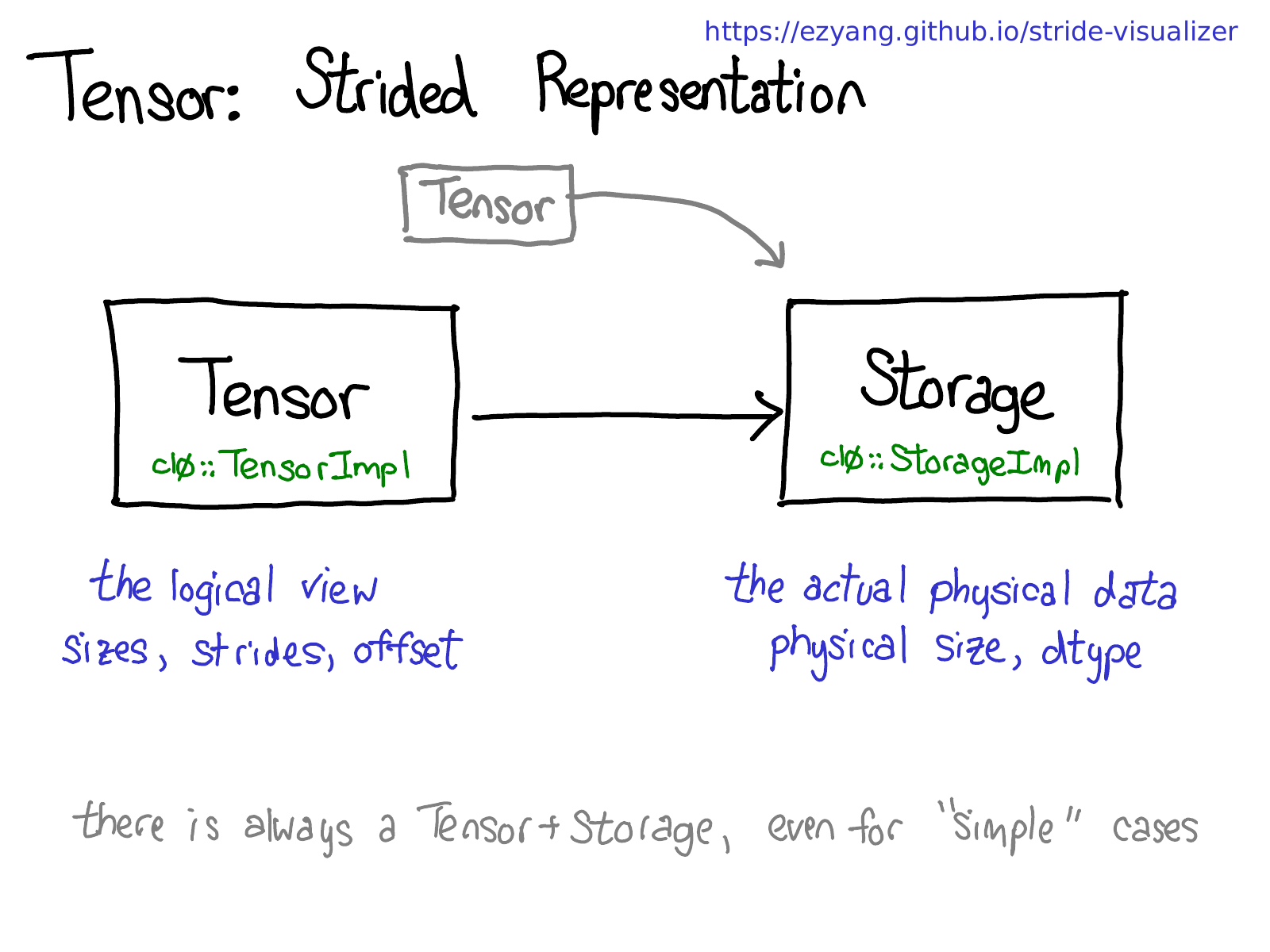
Yang (2019): The three-layer object hierarchy. Tensor is a thin Python-side handle (ref-counted pointer); TensorImpl holds all metadata (dtype, device, strides, sizes, AutogradMeta); Storage owns the raw byte buffer. Multiple TensorImpls can point to the same Storage, which is how views are implemented without copying data.
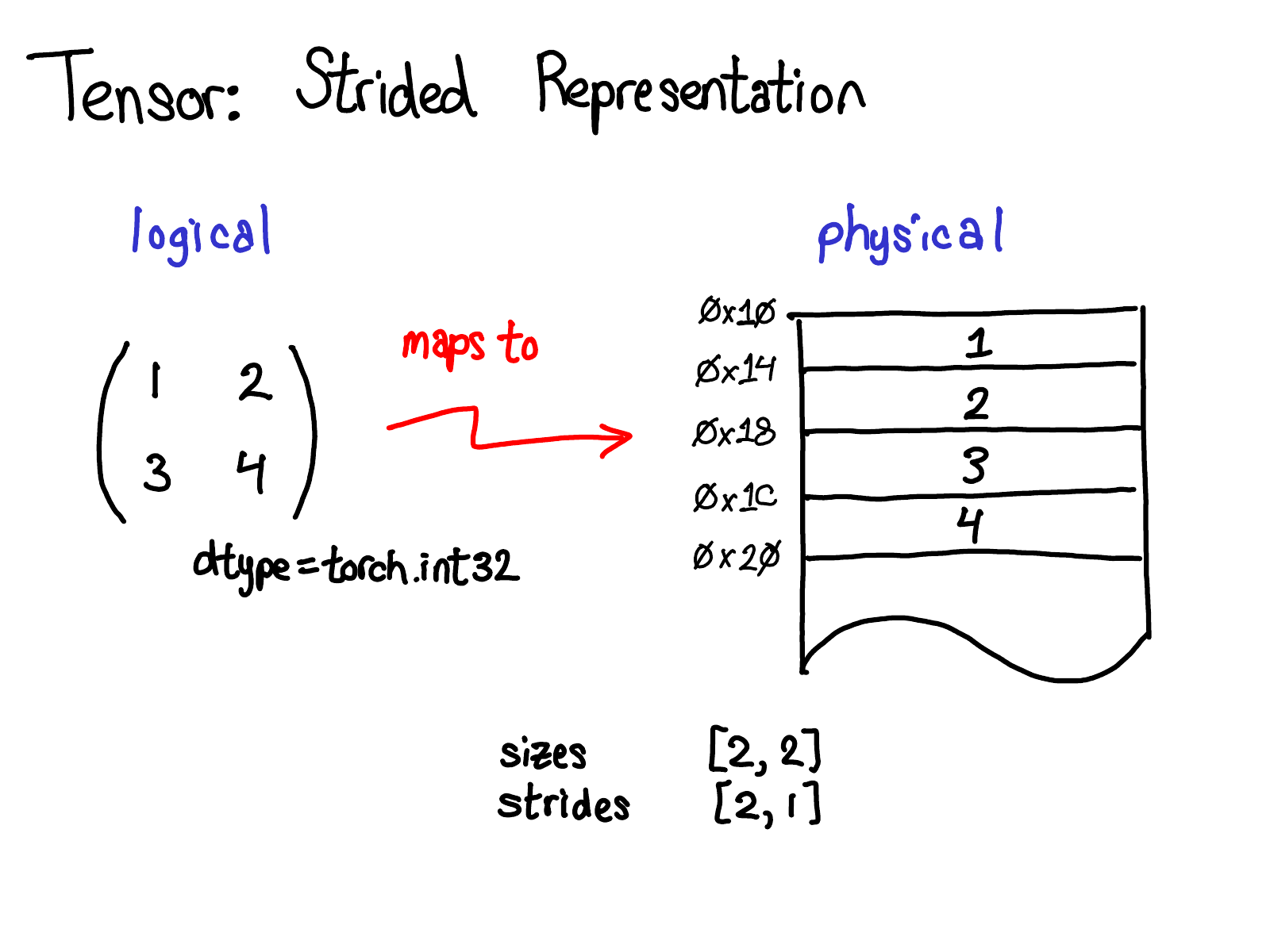
Yang (2019): Physical memory layout for a contiguous 2D tensor. Elements are stored row-major; the stride tuple [ncols, 1] encodes that stepping along dim-0 advances by ncols elements and stepping along dim-1 advances by 1.
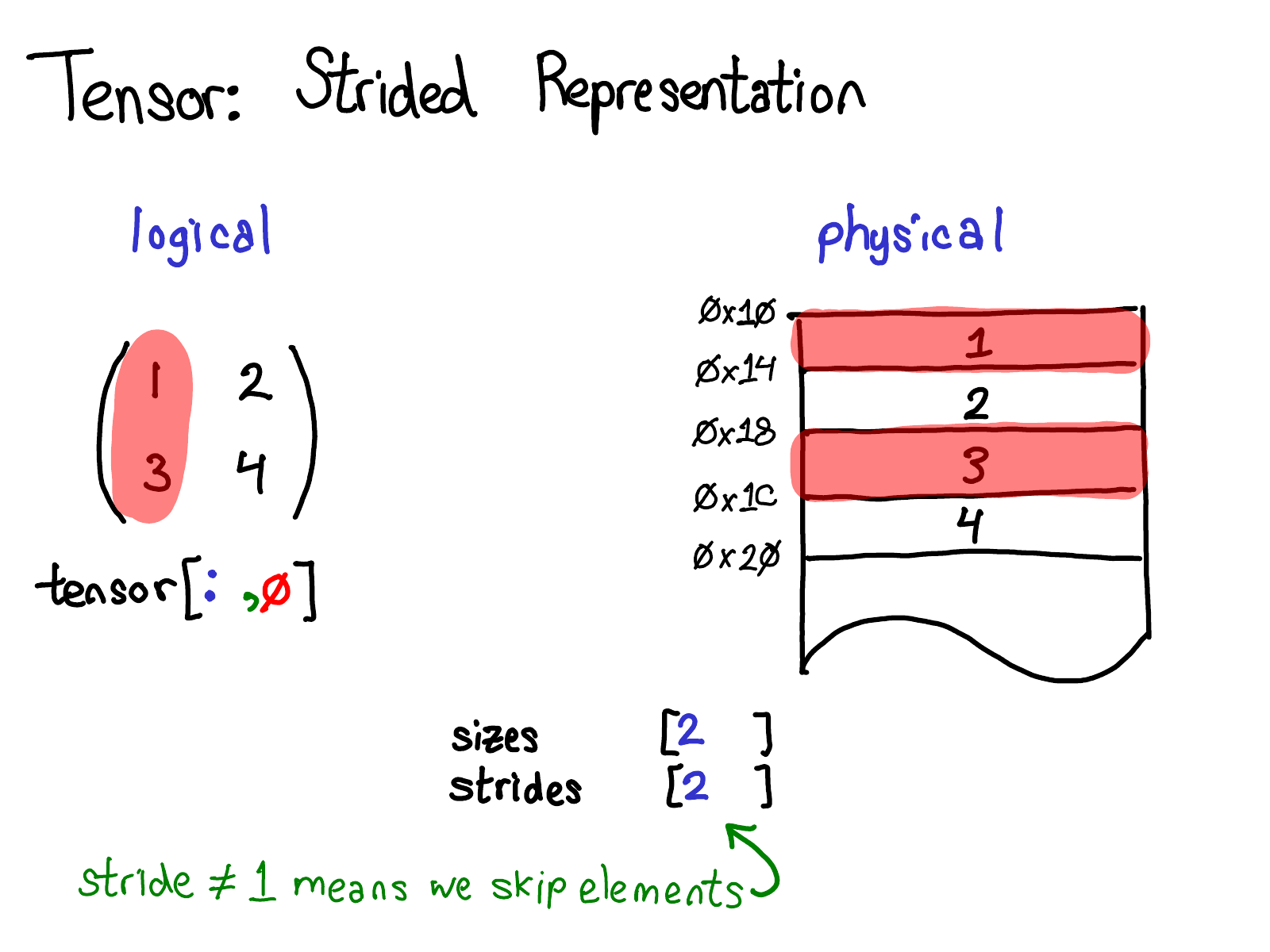
Yang (2019): A transposed or sliced view reuses the same Storage but changes the stride/offset fields in TensorImpl. No data is copied; is_contiguous() returns False when strides do not satisfy the row-major ordering invariant.
⚙️ Dispatch & Ops
| Subtopic | Key Idea | Primary Source |
|---|---|---|
| C10 dispatcher | Every torch.* call goes through a table lookup keyed by a DispatchKeySet bitmask computed from tensor arguments + thread-local state |
Yang 2020 |
| Dispatch key hierarchy | Keys are prioritized (e.g. Functionalize > Autograd > CUDA > CPU); the highest-priority key with a registered kernel wins |
Yang 2020 |
| Boxed vs. unboxed kernels | Boxed kernels receive IValue stacks and can be registered as catch-all fallbacks; unboxed kernels are type-safe C++ lambdas |
Yang 2020 |
| Operator registration | TORCH_LIBRARY declares a schema; TORCH_LIBRARY_IMPL registers a kernel per dispatch key; native_functions.yaml drives codegen for built-in ops |
ATen native README |
| Structured kernels | Meta + impl pattern: one implementation, three variants (functional/inplace/out=) auto-generated by codegen |
Codegen wiki |
🔄 Autograd
| Subtopic | Key Idea | Primary Source |
|---|---|---|
| Graph construction | Autograd registers at the Autograd dispatch key; forward wrapper wraps outputs in Variable, sets grad_fn to a Node, and calls collect_next_edges |
PyTorch blog 2021 |
| Node / Edge DAG | grad_fn is a Node; its next_edges_ are Edge structs pointing to input Nodes; leaves are AccumulateGrad nodes |
PyTorch blog 2021 |
| Backward scheduling | Engine::execute() uses a thread pool with GraphTask / NodeTask queues; nodes are ready when all dependencies are resolved |
PyTorch autograd blog 2021 |
derivatives.yaml |
Source of truth for JVP formulas; parsed by codegen to generate *Backward Node subclasses with apply() methods |
PyTorch autograd blog 2021 |
autograd.Function |
Python-level escape hatch for custom JVPs; setup_context + backward define the Node; apply() routes through the dispatcher |
PyTorch docs |
🚀 Compilation (TorchDynamo / TorchInductor)
| Subtopic | Key Idea | Primary Source |
|---|---|---|
| TorchDynamo bytecode interception | Hooks into CPython’s frame-evaluation API (PEP 523); rewrites bytecode to intercept Python ops and build torch.fx graph fragments |
Ansel et al. 2024 |
| Guard generation | Each compiled graph is guarded by tensor-shape/dtype/device assertions; guard failure triggers recompilation | Ansel et al. 2024 |
| AOTAutograd | Traces the joint forward+backward graph ahead-of-time so Inductor can fuse across the backward pass | Ansel et al. 2024 |
| PrimTorch | ~250 primitive ops that all backends must implement; upper-level ops decompose into prims at trace time | Ansel et al. 2024 |
| TorchInductor | Define-by-run loop-level IR using Python callables with SymPy symbolic sizes; lowers to Triton (GPU) or C++/OpenMP (CPU) | Ansel/jansel 2022 |
| Symbolic shapes | SymPy expressions track shape relationships; guards are inequalities over these; enables generalization across batch sizes | PyTorch compiler docs |
🧠 Memory Management
| Subtopic | Key Idea | Primary Source |
|---|---|---|
CUDACachingAllocator |
Maintains free-block pools (small ≤ 1 MiB, large > 1 MiB); malloc finds best-fit block, splits if needed |
DeVito 2022 |
| Block rounding | Small allocations round to 512 B; large allocations round to 2 MiB to reduce fragmentation | DeVito 2022 |
| Stream-local caches | Free blocks are stream-tagged; a block freed on stream A cannot be reused on stream B without sync | DeVito 2022 |
| OOM recovery | On OOM, allocator calls cudaFree on all cached-but-free blocks and retries |
DeVito 2022 |
| CUDA graphs | Graph capture requires the allocator to fix addresses; make_graphed_callables coordinates this |
Nguyen et al. 2021 |
🔧 Custom Operators
| Subtopic | Key Idea | Primary Source |
|---|---|---|
TORCH_LIBRARY schema |
Schema string declares name, arguments, return types, and aliasing annotations (Tensor(a!)) |
Custom ops tutorial |
TORCH_LIBRARY_IMPL |
Registers a kernel for a specific dispatch key (e.g. CUDA, CPU, Autograd) |
Custom ops tutorial |
| Autograd formula registration | setup_context + backward static methods on a torch.autograd.Function; or registerFakeImpl for abstract interpretation |
Custom ops tutorial |
torch.compile compatibility |
Custom ops must register a meta kernel (abstract/fake tensor) for Dynamo to trace through them symbolically | Custom ops tutorial |
🔗 Dependency Graph
flowchart TD
    TS["Tensor & Storage
tensor-storage.md"]
    D["Dispatcher
dispatcher.md"]
    AE["Autograd Engine
autograd-engine.md"]
    TC["torch.compile
torch-compile/overview.md"]
    MM["Memory Management
memory-management.md"]
    CO["Custom Ops
custom-ops.md"]

    TS --> D
    D --> AE
    D --> CO
    AE --> TC
    D --> TC
    TS --> MM
    AE --> CO
🚶 How PyTorch Works: A Brief Walkthrough
This section traces a minimal training step end-to-end through PyTorch’s internal machinery, grounding the subtopic map above in a concrete execution sequence.
The program:
x = torch.randn(4, 8, requires_grad=True, device="cuda")
y = torch.sin(x)
loss = y.sum()
loss.backward()
# x.grad is now populated
Step 1 — Tensor creation
torch.randn(...) allocates a Storage (a raw byte buffer) via CUDACachingAllocator, then constructs a TensorImpl pointing into that Storage with strides [8, 1] and offset 0. The Python-side Tensor object is a thin reference-counted handle to this TensorImpl. Because requires_grad=True, the TensorImpl also carries an AutogradMeta struct that marks it as a leaf variable whose gradient will accumulate into x.grad.
Yang (2019): The Tensor → TensorImpl → Storage ownership chain. The Tensor Python object is a thin ref-counted handle; TensorImpl holds all metadata including strides, dtype, and optional AutogradMeta; Storage is the raw byte buffer allocated by CUDACachingAllocator.
Step 2 — Dispatching torch.sin(x)
Calling torch.sin(x) crosses the Python/C++ boundary into the C10 dispatcher. The dispatcher computes a DispatchKeySet bitmask by inspecting the tensor arguments and thread-local state. For a CUDA tensor with requires_grad=True outside a torch.no_grad() block, the highest-priority active key is Autograd. The dispatcher finds the kernel registered at Autograd for aten::sin and calls it.
The
Autogradkernel is auto-generated fromnative_functions.yaml+derivatives.yamlat build time.
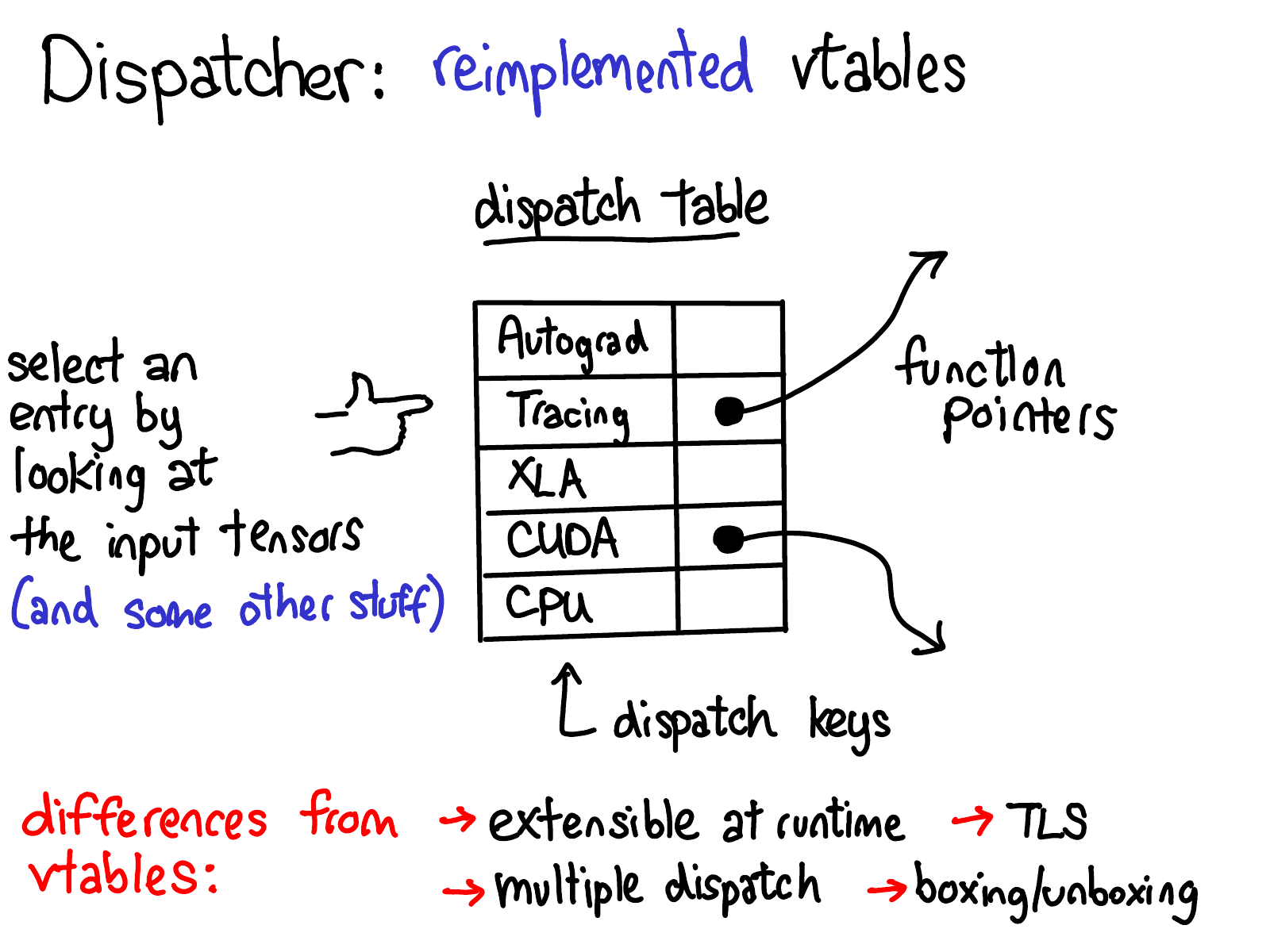
Yang (2020): The C10 dispatch table. Each operator (aten::sin, aten::add, …) has a row of function pointers, one per dispatch key (CPU, CUDA, Autograd, Tracing, …). The dispatcher selects the highest-priority key present in the computed DispatchKeySet and jumps to that cell.
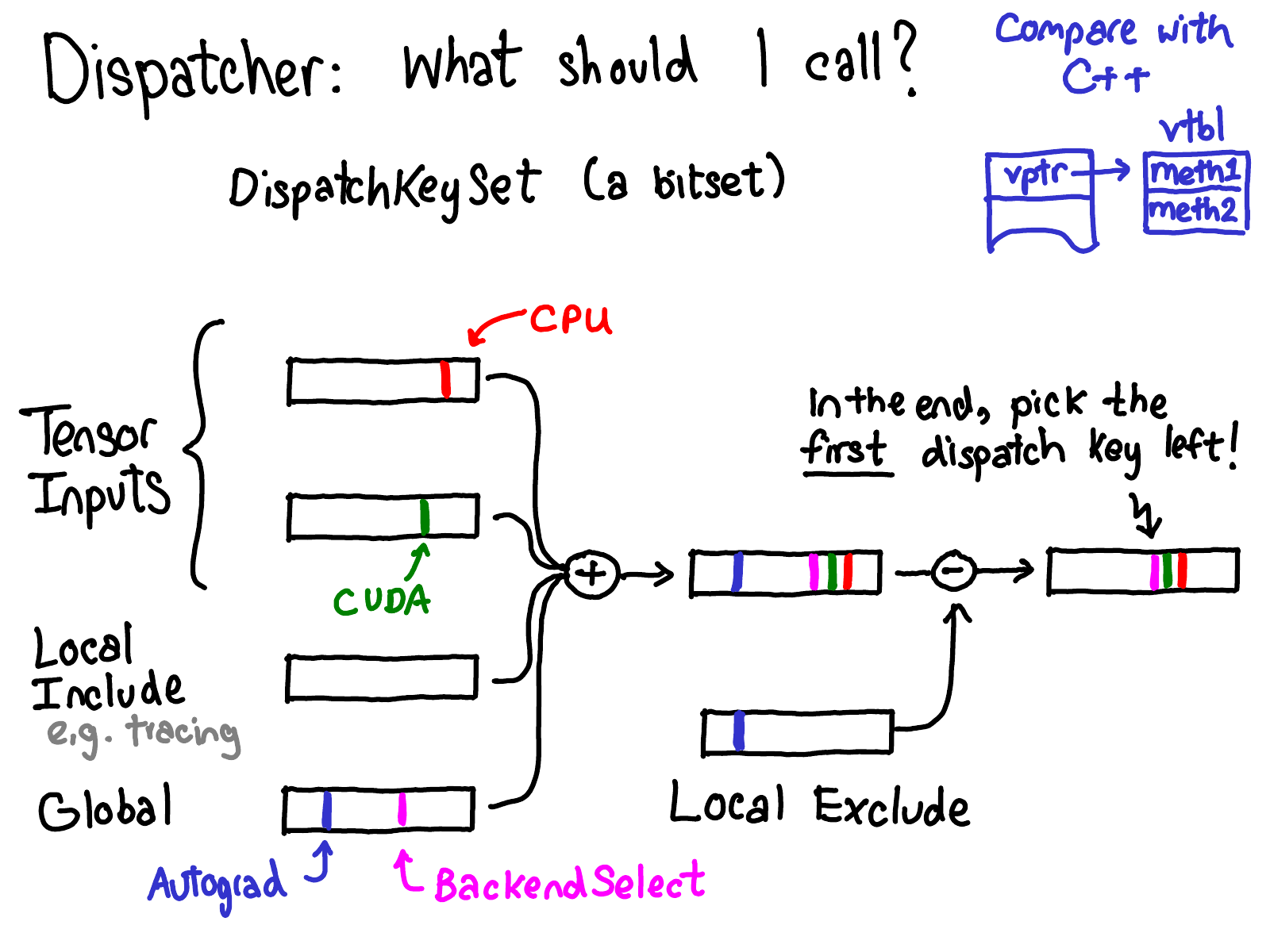
Yang (2020): How the DispatchKeySet bitmask is computed. It is the union of (1) the keys contributed by each tensor argument (device/layout bits), (2) a thread-local include set (e.g. Tracer when inside torch.jit.trace), and (3) a global default set — minus a thread-local exclude set (e.g. Autograd excluded inside torch.no_grad()).
Step 3 — Autograd forward wrapper
The Autograd-keyed kernel for sin is a wrapper, not the math. It:
- Saves inputs needed for the backward (here,
xitself, since \(\frac{d}{dx}\sin x = \cos x\) needs \(x\)). - Re-dispatches by excluding
Autogradfrom theDispatchKeySet, causing the dispatcher to fall through to the next key —CUDA. This runs the actual CUDA sin kernel, producing the output tensory. - Wraps the output: sets
y.grad_fn = SinBackward, aNodesubclass whosenext_edges_point tox’sAccumulateGradnode. This linksyinto the autograd DAG.
This two-pass structure — Autograd key builds the tape, CUDA key does the math — is repeated for every differentiable op.
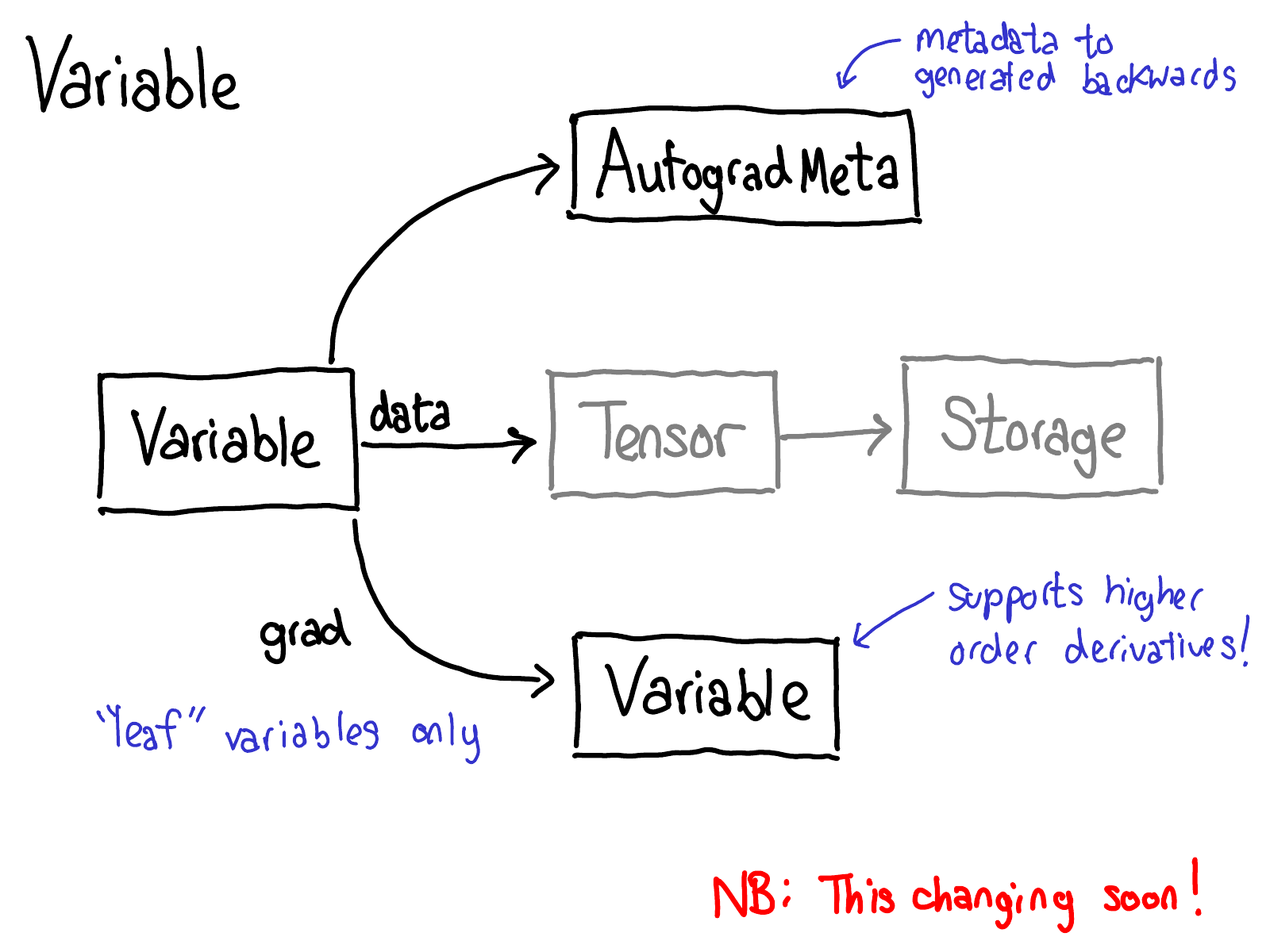
Yang (2019): The Variable abstraction (now unified into Tensor) carries an AutogradMeta payload inside TensorImpl. AutogradMeta holds the grad_fn pointer (the backward Node), the accumulated .grad tensor for leaf variables, and the requires_grad flag.
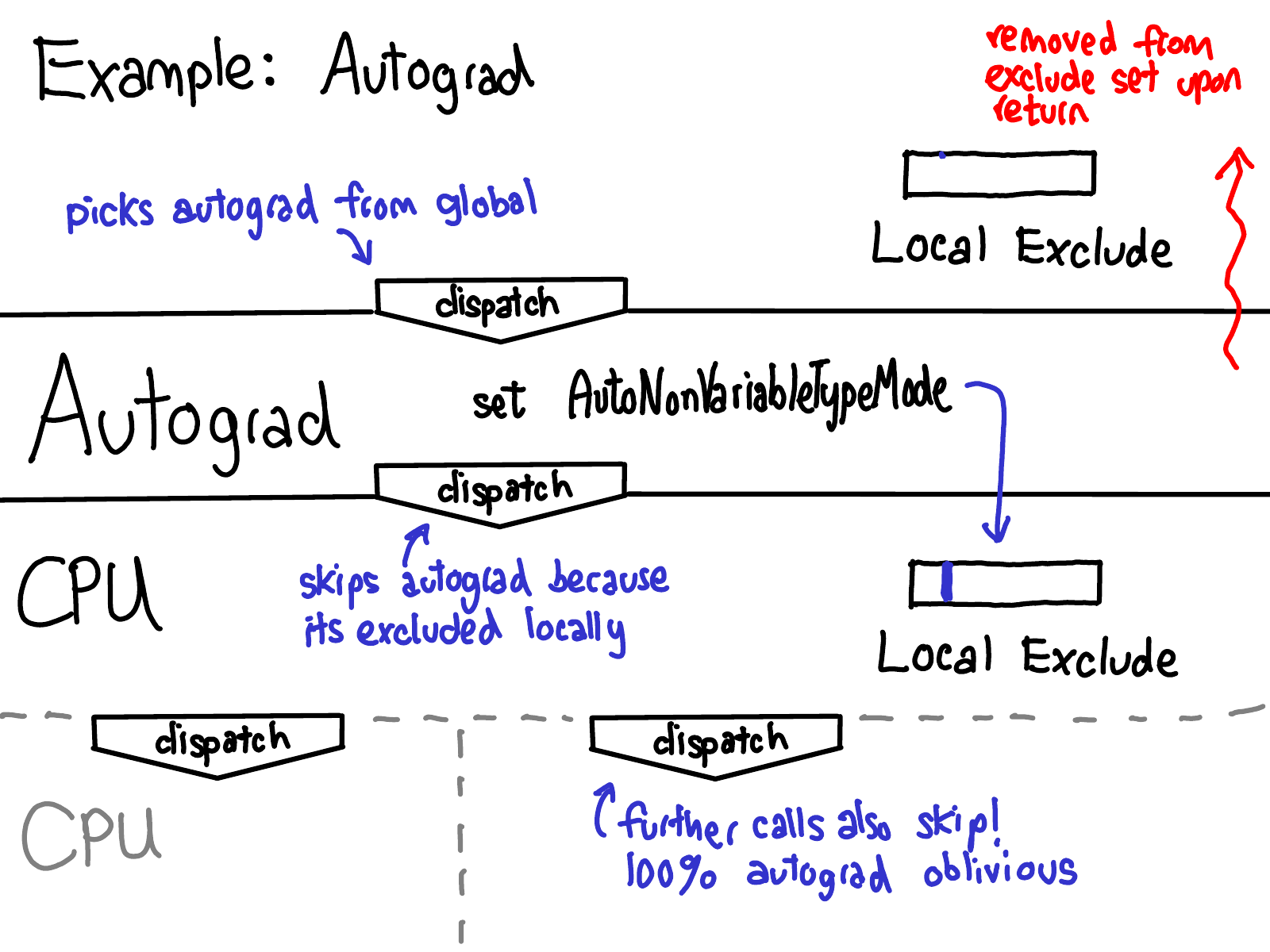
Yang (2020): The two-pass dispatch sequence for a differentiable op. The Autograd key fires first — its kernel saves inputs and prepares the grad_fn — then re-dispatches with Autograd excluded, falling through to the CUDA kernel that performs the actual computation. The output tensor is then wrapped to carry the newly constructed grad_fn.
Step 4 — Tape after the forward pass
After y = torch.sin(x) and loss = y.sum(), the autograd DAG looks like:
flowchart LR
    L["loss
(scalar)"]
    S["SumBackward
grad_fn of loss"]
    SB["SinBackward
grad_fn of y
saved: x"]
    AG["AccumulateGrad
leaf node for x"]

    L --> S
    S --> SB
    SB --> AG
Each Node stores:
- next_edges_: pointers to the Nodes of its inputs (the backward DAG edges).
- Saved tensors: intermediate values needed to compute the JVP (here, x inside SinBackward).
- A sequence_nr_: a monotonically increasing integer used by the engine to schedule execution priority.
Step 5 — loss.backward()
Engine::execute() performs a reverse topological traversal of the DAG using a thread-pool-backed priority queue:
- Seeds the queue with
(SumBackward, upstream_grad=tensor(1.0)). - Pops
SumBackward, calls itsapply(tensor(1.0)), which returnsones_like(y)— the gradient of sum w.r.t. its input. Enqueues(SinBackward, ones_like(y)). - Pops
SinBackward, callsapply(ones_like(y)). The JVP formula fromderivatives.yamlis \(\cos(x) \cdot \text{grad\_output}\). It loads the savedx, computescos(x) * ones_like(y), and sends the result toAccumulateGrad. AccumulateGradadds the incoming gradient intox.grad(allocating it on first call).
The engine dispatches each apply() call through the C10 dispatcher again — the gradient ops (cos, pointwise multiply) go through exactly the same Autograd → CUDA path as the forward ops, but because they are themselves not tracked (we are inside the backward), the Autograd key is disabled (via AutoGradMode::set_enabled(false)) and dispatch falls directly to CUDA.
Step 6 — Memory throughout
The CUDACachingAllocator services every tensor allocation in the above sequence — x’s storage, y’s storage, intermediate gradient buffers — without ever calling cudaMalloc after the first few warmup iterations. Freed tensors return their blocks to the pool; the next allocation performs a best-fit lookup in \(O(1)\) (small pool) or \(O(\log n)\) (large pool tree). The SinBackward node holds a reference to the saved x tensor, preventing its block from being reclaimed until the backward completes.
The full picture
flowchart TD
    PY["Python: torch.sin(x)"]
    DISP["C10 Dispatcher
compute DispatchKeySet"]
    AUTO["Autograd kernel
(save inputs, wrap output)"]
    REDISP["Re-dispatch (Autograd excluded)"]
    CUDA["CUDA kernel
actual math"]
    TAPE["Autograd DAG
SinBackward node added"]
    BWD["loss.backward()
Engine::execute()"]
    JVP["SinBackward::apply()
cos(x) * grad_out"]
    ACCUM["AccumulateGrad
x.grad += result"]
    ALLOC["CUDACachingAllocator
services all tensor allocs"]

    PY --> DISP
    DISP -->|"highest key: Autograd"| AUTO
    AUTO --> REDISP
    REDISP -->|"highest key: CUDA"| CUDA
    CUDA --> TAPE
    TAPE --> BWD
    BWD --> JVP
    JVP --> ACCUM
    ALLOC -.->|"allocates buffers"| CUDA
    ALLOC -.->|"allocates grad buffers"| JVP
Each box in this diagram corresponds to a subsystem with a planned deepdive note. The walkthrough above is the thread that ties them together.
📚 Potential Deepdives
The table below lists specific internal subsystems worth dedicated deep-dive notes, beyond the planned cluster files. These are not yet scheduled but represent natural next steps as the cluster matures.
| Area | Specific Topic | Why Interesting |
|---|---|---|
| Tensor internals | Version counter semantics and in-place op safety | Non-obvious why in-place ops break autograd without retain_graph |
| Tensor internals | TensorIterator — broadcast/type promotion/kernel dispatch for pointwise ops |
The machinery behind most elementwise ops; mediates CUDA/CPU kernel selection |
| Dispatcher | CompositeImplicitAutograd vs. CompositeExplicitAutograd — decomposition timing |
Determines when an op’s autograd formula is inherited vs. overridden |
| Dispatcher | Fallback kernels — PythonKey, Functionalize, BackendSelect |
How Python torch ops, functionalization, and autoselect work as cross-cutting concerns |
| Autograd | torch.autograd.Function — custom JVPs, setup_context, vmap support |
How user-level differentiable ops integrate with the Node/Edge DAG |
| Autograd | torch.func / functorch — functional transforms (vmap, grad, jacrev) |
Composable transforms via interpreter stack rather than tape mutation |
| Compiler | AOTAutograd — tracing joint forward/backward graphs ahead of time | Key to why torch.compile can fuse across backward passes |
| Compiler | TorchInductor Triton lowering — loop tiling, epilogue fusion, layout propagation | Where GPU-level performance gains actually come from |
| Compiler | Symbolic shapes in depth — SymPy guard generation, ShapeEnv |
How Dynamo generalizes across batch sizes without recompiling |
| Memory | memory_efficient_attention — how kernel-level memory savings interact with allocator |
Bridges custom CUDA kernel design and allocator behavior |
| Build system | native_functions.yaml + codegen pipeline |
Understanding where Python bindings, dispatch tables, and autograd wrappers come from |
| Build system | torch._C extension module and Python/C++ boundary |
How torch.add in Python becomes an ATen kernel invocation |
📖 Master References
| Reference | Authors | Year | What It Covers | Link |
|---|---|---|---|---|
| PyTorch Internals | Edward Z. Yang | 2019 | Canonical tour: TensorImpl/Storage/strides, ATen dispatch, Python/C++ boundary, autograd hooks | blog.ezyang.com |
| Let’s Talk About the PyTorch Dispatcher | Edward Z. Yang | 2020 | C10 dispatcher: dispatch-key set computation, three-way registration taxonomy, boxing/unboxing | blog.ezyang.com |
| How Computational Graphs are Constructed in PyTorch | Preferred Networks | 2021 | AutogradMeta, grad_fn / Node / Edge structures, collect_next_edges, codegen wrappers |
pytorch.org/blog |
| Overview of PyTorch Autograd Engine | Preferred Networks | 2021 | Backward pass: JVP evaluation, derivatives.yaml, gradient accumulation, Engine scheduling |
pytorch.org/blog |
| PyTorch 2: Faster ML Through Dynamic Bytecode Transformation | Ansel, Yang, He et al. | 2024 | TorchDynamo frame-eval hook, guard generation, AOTAutograd, PrimTorch, TorchInductor codegen | arXiv 2304.01277 |
| torch.fx: Practical Program Capture and Transformation | Reed, DeVito, He et al. | 2021 | torch.fx symbolic tracer, doubly-linked Graph IR (Node/placeholder/call-*), Python codegen |
arXiv 2112.08429 |
| TorchDynamo: Dynamic Python Bytecode Transformation | Jason Ansel | 2021 | Original Dynamo design doc: bytecode analysis, guard structure, FX fragment capture, Python fallback | dev-discuss.pytorch.org |
| TorchInductor: a PyTorch-native Compiler with Define-by-Run IR | Jason Ansel | 2022 | Inductor loop-level IR, SymPy symbolic sizes, Triton GPU codegen, C++/OpenMP CPU path | dev-discuss.pytorch.org |
| A Guide to PyTorch’s CUDA Caching Allocator | Zach DeVito | 2022 | Small/large pools, best-fit selection, 512 B/2 MiB rounding, stream-local caches, OOM recovery | zdevito.github.io |
| Debugging PyTorch Memory Use with Snapshots | Zach DeVito | 2022 | memory._snapshot() dumps, allocator block graph, flamegraph visualization, stack trace correlation |
zdevito.github.io |
| Accelerating PyTorch with CUDA Graphs | Nguyen et al. | 2021 | CUDA graph capture/replay, allocator coordination, make_graphed_callables, dynamic shape constraints |
pytorch.org/blog |
| Deep Dive to PyTorch AutoGrad (series) | Wentao Guo | 2021–22 | Source-level trace of autograd C++ call chain: Python → AutogradMeta → graph construction → engine |
wentao.site |
| Deep Dive to PyTorch Contiguous Operator (series) | Wentao Guo | 2021–22 | End-to-end trace of Tensor.contiguous() through dispatcher, TensorIterator, kernel execution |
wentao.site |
| PyTorch Dispatcher Walkthrough — GitHub Wiki | PyTorch Core Team | ongoing | Step-by-step C++ call stack for torch.add() through dispatch-key-set resolution and fallback |
github.com/pytorch/pytorch wiki |
| Codegen and Structured Kernels — GitHub Wiki | PyTorch Core Team | ongoing | native_functions.yaml → Python bindings, C++ headers, autograd wrappers, structured kernel pattern |
github.com/pytorch/pytorch wiki |
| ATen native/README.md | PyTorch Core Team | ongoing | native_functions.yaml schema syntax, aliasing markers, dispatch keywords, derivatives.yaml entries |
github.com |
| Autograd Mechanics — PyTorch Docs | PyTorch Core Team | ongoing | Version counters, retain_graph, multithreaded autograd, grad-mode/no-grad/inference-mode |
docs.pytorch.org |
| Custom C++ and CUDA Operators Tutorial | PyTorch Core Team | ongoing | Full TORCH_LIBRARY / TORCH_LIBRARY_IMPL workflow; schema; autograd registration; torch.compile compat |
docs.pytorch.org |
| Registering a Dispatched Operator in C++ | PyTorch Core Team | ongoing | Dispatcher-side custom op registration: boxed vs. unboxed, catch-all fallbacks, new backend keys | docs.pytorch.org |
| TorchDynamo Overview — PyTorch Docs | PyTorch Core Team | ongoing | Guard implementation, cache lookup, recompilation policy, graph-break behavior, explain() API |
docs.pytorch.org |