Multi-Agent Design: Optimizing Agents with Better Prompts and Topologies
Han Zhou, Xingchen Wan, Ruoxi Sun, Hamid Palangi, Shariq Iqbal, Ivan Vulić, Anna Korhonen, Sercan Ö. Arık ICLR 2026 · arXiv 2502.02533
| Dimension | Prior State | This Paper | Key Result |
|---|---|---|---|
| MAS design paradigm | Topology search is the primary lever; prompts treated as fixed or hand-crafted | Prompts and topologies are co-optimized in a three-stage pipeline | +8.5 pp average over multi-agent debate baseline across 8 benchmarks |
| Prompt role in MAS | Often overlooked; single-agent APO not extended to multi-agent blocks | Block-level + workflow-level APO both contribute independently and jointly | Block-level APO alone lifts average from 67.4% to 74.6% |
| Search space | Full combinatorial topology space with uniform sampling | Influence-weighted pruning focuses search on empirically effective building blocks | Topology search adds ~3 pp on top of prompt-optimized blocks |
| Generalization | Methods often tied to specific LLM backbone | MASS evaluated on Gemini 1.5 Pro, Claude 3.5 Sonnet, and Mistral Nemo-12B | Consistent +12–15 pp over CoT baseline across all three model families |
Relations
Builds on: MIPRO (Automatic Prompt Optimization) (no note yet), ADAS: Automated Design of Agentic Systems (no note yet), AFlow (no note yet) Concepts used: Neural Scaling Laws, Mixture of Experts
Table of Contents
- 1. Background and Motivation
- 2. The Design Space
- 3. The MASS Framework
- 4. Empirical Results
- 5. Design Principles
- 6. Comparison with Prior Automated MAS Methods
- 7. Limitations and Open Questions
- References
1. Background and Motivation 🤖
1.1 The Multi-Agent Design Problem
A multi-agent system (MAS) for language models is a computational graph in which multiple LLM-based agents, each with their own prompt (instruction text and optionally few-shot demonstrations), interact through a defined communication topology to produce a joint output on some task. The central design question is: given a task distribution \(\mathcal{D}\) over input-output pairs \((x, y)\), which agent prompt templates and which interaction topology jointly maximize expected task performance?
The difficulty is the size of the joint space. Prompt space is effectively unbounded — natural language instructions and demonstrations admit infinitely many variations. Topology space, even when restricted to a finite catalog of interaction patterns, is combinatorial in the number and configuration of agents. Prior work has addressed these two dimensions separately: hand-crafting prompts and searching topologies, or vice versa.
1.2 Why Multi-Agent Systems Improve Performance
The formal justification for multi-agent systems rests on ensemble diversity. If each of \(N\) agents independently produces the correct answer with probability \(p > 0.5\), the probability that the majority vote is wrong is:
\[P(\text{majority wrong}) = \sum_{k > N/2} \binom{N}{k} (1-p)^k p^{N-k}\]
This bound decreases exponentially in \(N\) — majority voting concentrates probability mass on the correct answer as agents are added, provided they make independent errors. For LLM-based agents sharing the same backbone, true independence is impossible, but functional diversity arises from prompt variation, role specialization, and sampling randomness.
Du et al. (2023) instantiate this with debate: when multiple LLM instances exchange competing claims and are required to defend their answers, factual accuracy improves because incorrect confident claims face explicit adversarial pressure. Wang et al. (2023) demonstrate a simpler version via self-consistency: sampling \(k\) independent chain-of-thought traces and taking majority vote over final answers consistently outperforms single greedy decoding, purely by reducing variance in reasoning paths.
Beyond voting, multi-agent systems enable division of cognitive labor: separate agents can specialize in subtasks (decomposition, verification, synthesis), analogous to role-based routing in Mixture of Experts architectures. The critical question — which this paper answers — is which combination of specialization, aggregation, and interaction rounds yields the best return on tokens spent.
1.3 A Taxonomy of Interaction Topologies
Agent interaction topologies vary along two axes: directionality (how information flows) and connectivity (the graph structure). Six canonical patterns appear across the literature:
| Topology | Connectivity | Information Flow | Representative Systems |
|---|---|---|---|
| Sequential | Linear chain | Unidirectional; each agent processes and forwards | HuggingGPT (Shen et al., 2023) |
| Parallel (aggregation) | Star/broadcast | One producer → many independent voters → aggregator | Self-Consistency (Wang et al., 2023) |
| Self-critique (reflection) | Self-loop | Agent critiques its own output and revises iteratively | Reflexion (Shinn et al., 2023), Self-Refine (Madaan et al., 2023) |
| Debate | Fully-connected | Agents exchange competing claims; consensus via synthesis | Du et al. (2023) |
| Hierarchical | Rooted tree | Controller decomposes task, dispatches to workers, synthesizes | AutoGen (Wu et al., 2023) |
| Peer graph | Arbitrary graph | Agents communicate with neighbors; no central authority | Generative Agents (Park et al., 2023) |
MASS spans most of this taxonomy through its five building blocks. Aggregate instantiates parallel aggregation; Reflect is self-critique; Debate is debate; Summarize is a sequential preprocessing step; Tool-use extends any topology with environment interaction. The key design parameters are depth (rounds of interaction: \(N_r, N_d\)) and width (agents in parallel: \(N_a\)). G-Designer (Zhuge et al., 2024) extends the learned-topology direction further by encoding agents and tasks as nodes in a variational graph autoencoder, generating task-adaptive sparse graphs that match dense hand-crafted ones at 95% fewer tokens.
1.4 Agentic Design Patterns
Design patterns for agents are canonical, reusable architectures — analogous to software design patterns — that package a recurring interaction structure. Five patterns directly underlie MASS’s building blocks:
Chain-of-Thought (Wei et al., 2022): The primitive reasoning step. Agents decompose problems into explicit intermediate steps before producing a final answer. Every MASS agent role incorporates CoT via its optimized instruction; block-level APO discovers which CoT style is most effective for each role.
Tool-use (Schick et al., 2023 — Toolformer; Yao et al., 2023 — ReAct): Agents call external tools (code interpreters, search engines, APIs) mid-reasoning. ReAct interleaves reasoning traces with environment actions in a single loop; Toolformer learns self-supervised API calls. MASS’s Tool-use block is the binary activation of this pattern (\(N_T \in \{0, 1\}\)).
Reflection (Shinn et al., 2023 — Reflexion; Madaan et al., 2023 — Self-Refine): An agent critiques its own output using a linguistic feedback signal — either from a separate critic or self-generated — and iteratively revises. Reflexion stores feedback in episodic memory and outperforms ReAct on code generation without gradient updates. MASS’s Reflect block runs \(N_r\) critique-revision rounds.
Debate (Du et al., 2023): Multiple agents present competing answers; a synthesizer produces a consensus. Structured argumentation forces models to articulate and defend positions, reducing confident hallucination. MASS’s Debate block runs \(N_d\) exchange rounds across \(\geq 2\) predictor agents plus one dedicated debater/synthesizer.
Hierarchical decomposition (Shen et al., 2023 — HuggingGPT): A planner decomposes a complex task into a DAG of subtasks, dispatches each to a specialist agent, and synthesizes results. This is the architectural basis for multi-hop QA and code generation pipelines evaluated in MASS. Surprisingly, explicit hierarchical decomposition is not among MASS’s building blocks — MASS achieves multi-hop gains instead through Debate topology, which forces cross-agent factual checking.
1.5 Automated MAS Design: Prior Work
Automated Design of Agentic Systems (ADAS; Hu et al., 2024) uses a meta-agent that iteratively proposes new agent system code. While expressive, it achieves only marginal empirical gains because it does not systematically optimize agent-level prompts before composing agents into workflows. AFlow (Zhang et al., 2024) applies Monte Carlo Tree Search over a predefined operator library to discover effective workflows, but its meta-prompt is not backbone-agnostic, complicating fair comparison across LLMs — the meta-optimizer must be Claude 3.5 Sonnet regardless of the executor model.
The shared failure mode is asymmetric treatment of the two design axes: topology receives algorithmic attention while prompts are left sub-optimized, or vice versa. Neither axis is sufficient alone: a well-searched topology running sub-optimal prompts is beaten by a well-prompted single agent (§4.4), and a well-optimized single agent misses the gains from structured multi-agent interaction. MASS addresses this by treating both axes as co-equal optimization targets, staged to respect their natural dependency ordering.
2. The Design Space 📐
2.1 Agent Configuration
Each agent \(a\) is characterized by: - A role prompt \(p_{\text{inst}} \in \mathcal{P}\) — a natural-language instruction string - A demonstration set \(p_{\text{demo}} \subseteq \mathcal{D}^k\) — up to \(k\) few-shot exemplars - A model backbone \(\mathcal{M}\) — the underlying LLM
Let \(a = (p_{\text{inst}}, p_{\text{demo}}, \mathcal{M})\) and let \(\mathcal{A}\) denote the space of all agent configurations.
2.2 Topology Building Blocks
💡 MASS defines a finite catalog of five topology building blocks, each parameterized by a count or binary variable. A workflow is built by composing these blocks.
Definition (Topology Building Blocks). The five building blocks are:
| Block | Symbol | Parameter \(N\) | Semantics |
|---|---|---|---|
| Aggregate | \(\mathcal{T}_{\text{agg}}\) | \(N_a \in \{1,3,5,7,9\}\) | \(N_a\) parallel agents; majority-vote or consistent-prediction aggregation |
| Reflect | \(\mathcal{T}_{\text{ref}}\) | \(N_r \in \{0,1,2,3,4\}\) | \(N_r\) rounds of self-critique and revision |
| Debate | \(\mathcal{T}_{\text{deb}}\) | \(N_d \in \{0,1,2,3,4\}\) | \(N_d\) rounds of multi-agent opinion exchange; requires \(\geq 2\) predictors + 1 debater |
| Summarize | \(\mathcal{T}_{\text{sum}}\) | \(N_s \in \{0,1,2,3,4\}\) | Long-context compression via \(N_s\) abstraction rounds |
| Tool-use | \(\mathcal{T}_{\text{tool}}\) | \(N_T \in \{0,1\}\) | Binary: include external retrieval or code execution |
Each block contributes independently to the workflow when activated (parameter \(> 0\)).
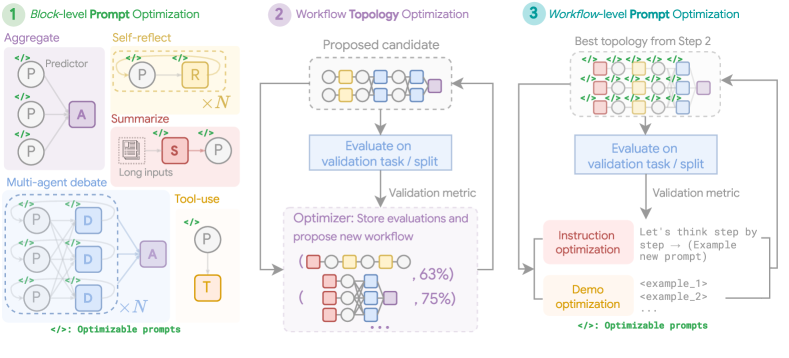 Figure 4 (Zhou et al., 2025): The five topology building blocks — Aggregate, Reflect, Debate, Summarize, and Tool-use — and how they compose into a full workflow. Each block is independently parameterized by a count or binary variable, and the predefined composition order is Summarize → Reflect → Debate → Aggregate.
2.3 Combined Search Space
A full configuration is a tuple \(\mathbf{a} = (a_0, a_1, \ldots, a_K, N_a, N_r, N_d, N_s, N_T)\) where \(a_0\) is the base predictor and \(a_1, \ldots, a_K\) are the specialized agents for each activated block. The total number of agents \(\mathcal{N}(\mathbf{a})\) must satisfy a budget constraint \(\mathcal{N}(\mathbf{a}) < B\).
The search space \(\mathcal{A}\) is the Cartesian product of: - Unbounded prompt space for each agent role - Discrete parameter spaces \(\{1,3,5,7,9\} \times \{0,\ldots,4\}^3 \times \{0,1\}\) for the five blocks
This space is intractably large without structure. MASS’s key contribution is imposing staged optimization and influence-based pruning to render it tractable.
3. The MASS Framework 🔑
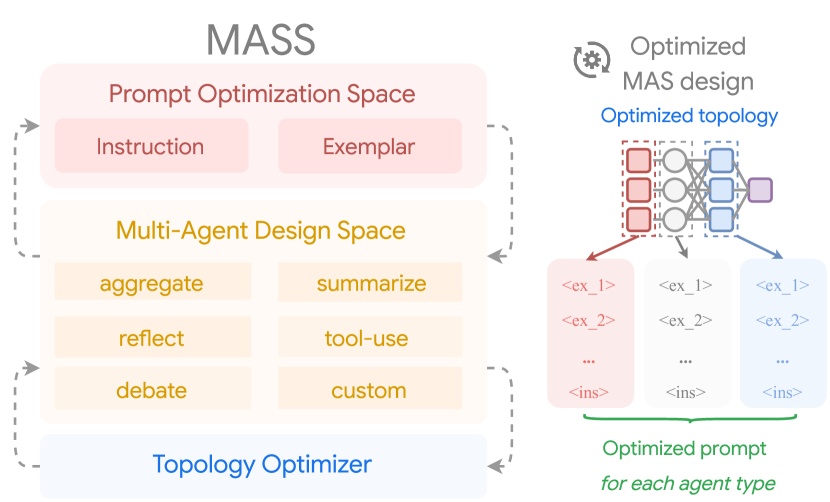 Figure 1 (Zhou et al., 2025): The MASS framework. A hand-crafted MAS (left) is transformed into an optimized design (right) by interleaving block-level prompt optimization, influence-weighted topology search, and workflow-level prompt optimization.
3.1 Formal Optimization Objective
Definition (MAS Optimization Problem). Let \(\mathcal{W}(\mathbf{a})(x)\) denote the output of workflow \(\mathcal{W}\) instantiated with configuration \(\mathbf{a}\) on input \(x\). The optimization objective is:
\[\mathbf{a}^* = \arg\max_{\mathbf{a} \sim \mathcal{A}} \; \mathbb{E}_{(x,y) \sim \mathcal{D}} \left[ f\!\left(\mathcal{W}(\mathbf{a})(x),\, y\right) \right]\]
where \(f(\cdot, \cdot)\) is a task-specific scoring function (e.g., exact match, execution accuracy). Because \(\mathcal{A}\) is combinatorially large, MASS decomposes this into three sequential sub-problems.
3.2 Stage 1: Block-Level Prompt Optimization
💡 The first stage optimizes agent prompts independently for each building block, conditioning on a fixed base agent.
Step 1a — Base agent optimization. Given an initial base predictor \(a_0\) with default instruction and no demonstrations, run automatic prompt optimization (MIPRO) on \(\mathcal{D}\):
\[a_0^* \leftarrow \mathcal{O}_{\mathcal{D}}(a_0)\]
MIPRO jointly optimizes instructions and demonstrations. Concretely: it generates 10 instruction candidates per agent (incorporating dataset summaries and diversity hints), bootstraps up to 3 demonstrations from the model’s correct validation predictions, and runs 10 optimization rounds via Bayesian search over the combined space.
Step 1b — Block-conditioned optimization. For each topology block \(\mathcal{T}_i\) with its associated agent role \(a_i\), optimize \(a_i\) conditioned on \(a_0^*\):
\[a_i^* \leftarrow \mathcal{O}_{\mathcal{D}}(a_i \mid a_0^*)\]
Step 1c — Influence scoring. Define the incremental influence of block \(i\) as the ratio of its optimized performance to baseline:
\[I_{a_i} = \frac{\mathcal{E}(a_i^*)}{\mathcal{E}(a_0^*)}\]
where \(\mathcal{E}(\cdot)\) denotes empirical accuracy on a held-out validation split. A block with \(I_{a_i} > 1\) provides net benefit; \(I_{a_i} < 1\) indicates degradation.
3.3 Stage 2: Workflow Topology Optimization
⚙️ Stage 2 uses the influence scores from Stage 1 to bias the topology search toward productive building blocks.
Definition (Influence-Weighted Sampling). The inclusion probability for block \(i\) is:
\[p_{a_i} = \text{Softmax}(I_{a_i}, t)\]
where \(t = 0.05\) is a temperature parameter that sharpens the distribution, concentrating probability mass on high-influence blocks. For each candidate workflow configuration, each block dimension \(a_i\) is included by drawing \(u \sim \text{Uniform}(0,1)\) and retaining the block iff \(u \leq p_{a_i}\).
Rejection sampling. Configurations violating the agent budget \(\mathcal{N}(\mathbf{a}) \geq B\) are rejected and resampled. This ensures computational feasibility without biasing the marginal inclusion probabilities.
Topology ordering. The predefined composition order is: Summarize → Reflect → Debate → Aggregate. This ordering reflects the natural information flow: compress context first, then refine individual outputs, then debate across agents, then aggregate.
The topology search evaluates \(M\) sampled configurations on the validation set and selects the best-performing workflow \(\mathcal{W}^*\).
3.4 Stage 3: Workflow-Level Prompt Optimization
🔑 Stage 3 re-runs APO on the entire best workflow \(\mathcal{W}^*\) end-to-end, allowing agent prompts to adapt to the multi-agent context they will operate in.
\[\mathbf{a}^* \leftarrow \mathcal{O}_{\mathcal{D}}\!\left(\mathbf{a}_{\mathcal{W}^*}\right)\]
The rationale is that agent roles are not independent in context: a reflector agent’s optimal instruction differs depending on whether a debate stage follows. Block-level optimization (Stage 1) treats each agent in isolation; Stage 3 captures these interdependencies.
Key conclusion: the three stages are not interchangeable in ordering. Local optimization must precede topology search (otherwise topology is evaluated on sub-optimal agents), and topology must be fixed before global optimization (otherwise the prompt adapts to the wrong workflow structure). Each stage contributes approximately 3–7 percentage points of additional accuracy on average.
4. Empirical Results 📊
4.1 Main Results on Gemini 1.5 Pro
Benchmarks span mathematical reasoning (MATH), discrete reasoning over text (DROP), multi-hop QA (HotpotQA, MuSiQue, 2WikiMQA), and code generation (MBPP, HumanEval, LiveCodeBench). All scores are accuracy (%) averaged over three seeds.
| Task | CoT | Self-Consistency | Multi-Agent Debate | ADAS | MASS |
|---|---|---|---|---|---|
| MATH | 71.67 | 77.33 | 78.67 | 80.00 | 84.67 |
| DROP | 70.59 | 74.06 | 71.78 | 72.96 | 90.52 |
| HotpotQA | 57.43 | 58.60 | 64.87 | 65.88 | 69.91 |
| MuSiQue | 37.81 | 41.81 | 46.00 | 41.95 | 51.40 |
| 2WikiMQA | 63.39 | 67.79 | 71.78 | 71.14 | 73.34 |
| MBPP | 68.33 | 69.50 | 68.67 | 73.00 | 86.50 |
| HumanEval | 86.67 | 86.00 | 86.67 | 87.67 | 91.67 |
| LiveCodeBench | 66.33 | 70.33 | 73.67 | 65.17 | 82.33 |
| Average | 65.28 | 68.18 | 70.26 | 69.72 | 78.79 |
MASS achieves 78.79% average accuracy, a +8.5 pp improvement over multi-agent debate and +9.1 pp over ADAS.
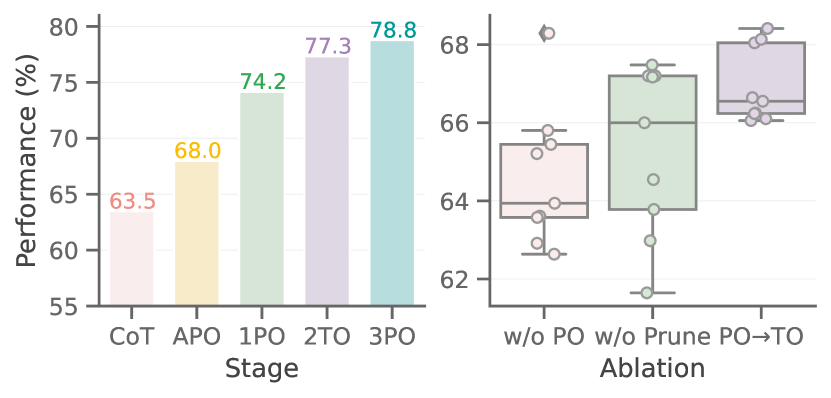 Figure 5 (Zhou et al., 2025): Left — average performance across 8 tasks on Gemini 1.5 Pro as each MASS stage is added (Base CoT → APO → 1PO → 2TO → 3PO). Right — comparative ablation on topology optimization strategies, showing influence-weighted sampling outperforms uniform search.
4.2 Ablation Study
The ablation incrementally applies each stage of MASS on top of the preceding stage (Gemini 1.5 Pro):
| Configuration | MATH | DROP | HotpotQA | MuSiQue | 2WikiMQA | MBPP | HumanEval | LCB | Avg. |
|---|---|---|---|---|---|---|---|---|---|
| Base CoT | 62.33 | 71.65 | 56.96 | 43.32 | 49.20 | 68.83 | 89.33 | 66.33 | 63.54 |
| + APO (base agent) | 79.33 | 77.51 | 59.72 | 43.97 | 61.49 | 67.00 | 86.33 | 68.50 | 67.44 |
| + 1PO (block prompts) | 80.00 | 86.45 | 62.52 | 48.86 | 67.40 | 80.33 | 91.67 | 76.00 | 74.56 |
| + 2TO (topology search) | 83.00 | 86.75 | 65.22 | 52.61 | 72.82 | 85.00 | 92.00 | 81.33 | 77.55 |
| + 3PO (workflow prompts) | 84.67 | 90.52 | 69.91 | 51.40 | 73.34 | 86.50 | 91.67 | 82.33 | 78.40 |
Each stage contributes positively in aggregate. Note the non-monotonicity on MuSiQue at Stage 3PO (51.40 vs. 52.61): workflow-level re-optimization can occasionally specialize prompts away from the configuration optimal for that task alone — a known risk of joint optimization over multi-component systems.
4.3 Cross-Model Generalization
MASS is evaluated across three model families to assess backbone dependence:
| Model | CoT Baseline | MASS | Delta |
|---|---|---|---|
| Gemini 1.5 Pro | 65.28 | 78.79 | +13.5 pp |
| Claude 3.5 Sonnet | 60.21 | 72.43 | +12.2 pp |
| Mistral Nemo-12B | 40.40 | 55.90 | +15.5 pp |
MASS delivers consistent double-digit improvements across all three backbone families. The relative gain is largest for the weakest model (Mistral Nemo-12B), suggesting that structured prompt and topology optimization is especially valuable when the base model has lower instruction-following capacity.
Note: AFlow requires Claude 3.5 Sonnet as the meta-optimizer regardless of executor LLM, making cross-backbone comparison to AFlow methodologically fraught.
4.4 Token Efficiency
⚠️ A critical finding is that prompt-optimized single agents frequently outperform multi-agent scaling approaches when token budget is held fixed. Spending tokens on better prompts for a single agent can dominate spending the same tokens on additional agents running default prompts. This challenges the naive scaling intuition that more agents is always better.
The implication: topology complexity should be justified by demonstrated task-specific benefit (measurable via influence scoring), not assumed to be universally helpful.
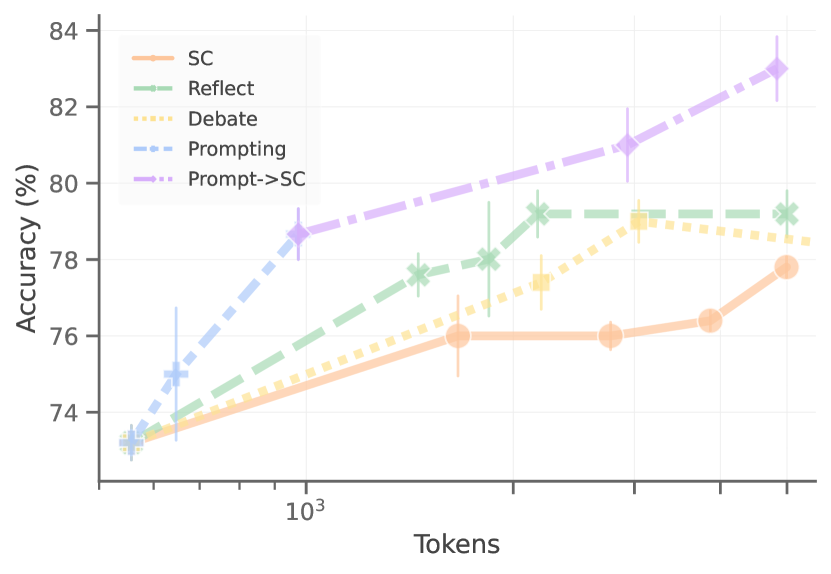 Figure 2 (Zhou et al., 2025): Token efficiency comparison on MATH with Gemini 1.5 Pro. A prompt-optimized single agent (APO) achieves better accuracy-per-token than self-consistency, self-refine, or multi-agent debate scaling at equivalent token budgets — demonstrating that prompt quality dominates raw agent count.
5. Design Principles 💡
5.1 Task-Topology Affinity
Not all topologies improve performance on all tasks. The paper identifies a pattern:
| Task Type | Effective Topologies | Rationale |
|---|---|---|
| Multi-hop QA (HotpotQA, MuSiQue, 2WikiMQA) | Debate | Debate elicits truthful cross-checking across agents on factual chains |
| Mathematical reasoning (MATH, DROP) | Aggregate (self-consistency) | Multiple independent samples reduce variance on deterministic reasoning |
| Code generation (MBPP, HumanEval, LCB) | Reflect + Tool-use | Execution feedback enables precise error correction |
Surprisingly, on some multi-hop tasks, topologies like Aggregate and Reflect actually degrade performance relative to a well-prompted single agent, highlighting that blanket multi-agent composition is not a safe default.
5.2 Optimization Ordering
Three overarching design principles emerge:
Principle 1 (Local before global). Optimizing individual agents properly before composing them into workflows outweighs the gains from complex unoptimized topologies. A well-prompted single agent defeats a poorly-prompted multi-agent system.
Principle 2 (Influence-guided search). High-influence building blocks represent a small fraction of the full topology space. Concentrating search budget on these blocks via influence-weighted sampling is more sample-efficient than uniform exploration.
Principle 3 (Interdependence matters). Workflow-level joint optimization captures prompt interdependencies that block-level optimization misses. The optimal instruction for a Reflect agent depends on the Debate context it will receive.
6. Comparison with Prior Automated MAS Methods 🔍
| Method | Prompt Optimization | Topology Search | Backbone Agnostic | Avg. Accuracy (Gemini 1.5 Pro) |
|---|---|---|---|---|
| CoT | None (default) | None (fixed single agent) | Yes | 65.28 |
| Self-Consistency | None | Fixed (parallel sample) | Yes | 68.18 |
| Multi-Agent Debate | None | Fixed (debate) | Yes | 70.26 |
| ADAS | Implicit (meta-agent) | LLM-generated code | Yes | 69.72 |
| AFlow | None explicit | MCTS over operators | Partially (meta uses Claude) | ~70 |
| MASS | Block + workflow APO | Influence-weighted sampling | Yes | 78.79 |
ADAS proposes complex topologies but achieves only subtle gains because prompt optimization is not systematically applied to each block. AFlow brings competitive topology search via MCTS but lacks the prompt optimization stages that account for the majority of MASS’s gain.
7. Limitations and Open Questions 🔍
- Communication topology: Debate currently assumes fully-connected agent communication. Sparse or structured communication graphs (e.g., ring, tree) could improve efficiency without sacrificing performance.
- Search algorithm: The influence-weighted sampling approach is a heuristic. Bayesian optimization or other structured search methods over the topology space could improve sample efficiency.
- Error-based feedback: APO in MASS uses correct predictions for demonstration bootstrapping. Incorporating error logs and failure analysis into the prompt optimizer could yield higher-quality instructions.
- Dynamic topologies: MASS discovers a fixed workflow at optimization time. Adaptive topologies that select routing at inference time (cf. Mixture of Experts-style routing) remain unexplored in this setting.
- Search space coverage: The five building blocks are comprehensive but not exhaustive. Specialized topologies for structured generation or tool-augmented reasoning could extend the framework.
References
| Reference Name | Brief Summary | Link to Reference |
|---|---|---|
| Zhou et al. (2025) — MASS | Introduces MASS: three-stage MAS optimization via block APO, influence-weighted topology search, and workflow APO | arXiv 2502.02533 |
| MIPRO (Opsahl-Ong et al., 2024) | Automatic prompt optimization jointly over instructions and few-shot demonstrations using Bayesian search | arXiv 2406.11695 |
| ADAS (Hu et al., 2024) | LLM meta-agent that iteratively proposes and evaluates new agentic systems in code | arXiv 2408.08435 |
| AFlow (Zhang et al., 2024) | Monte Carlo Tree Search over predefined agentic operators to discover effective workflows | arXiv 2410.10762 |
| Du et al. (2023) — Multi-Agent Debate | Demonstrates that debate between LLM agents improves factual accuracy and reasoning | arXiv 2305.14325 |
| Wang et al. (2023) — Self-Consistency | Samples multiple reasoning chains and takes majority vote to improve CoT accuracy | arXiv 2203.11171 |
| Madaan et al. (2023) — Self-Refine | Iterative self-feedback and revision loop for LLM output improvement | arXiv 2303.17651 |
| Gemini 1.5 Pro (Google, 2024) | Primary backbone LLM used in MASS main experiments | arXiv 2403.05530 |
Agent Topologies
| Reference Name | Brief Summary | Link to Reference |
|---|---|---|
| Guo et al. (2024) — LLM-based Multi-Agents Survey | IJCAI 2024 survey categorizing LLM multi-agent systems across five streams: framework design, orchestration, problem solving, world simulation, and benchmarks. Most widely cited taxonomy of agent profiling and communication. | arXiv 2402.01680 |
| Wang et al. (2024) — Autonomous Agents Survey | Unified agent framework covering planning, memory, tool use, and action; foundational reference for the functional modules that nodes in a multi-agent graph must implement. | arXiv 2308.11432 |
| Chen et al. (2025) — Multi-Agent Collaboration Mechanisms | Systematically characterizes collaboration along five dimensions: actors, type (cooperation/competition/coopetition), structure (peer-to-peer, centralized, distributed), strategy, and coordination protocols. Most structurally precise survey of communication topology variants. | arXiv 2501.06322 |
| Liu et al. (2025) — Topological Structure Learning as Research Priority | Position paper formally identifying topology — agent selection, structure profiling, topology synthesis — as an underexplored dimension in LLM-MAS; proposes a three-stage framework for topology-aware system design. | arXiv 2505.22467 |
| Zhuge et al. (2024) — G-Designer | Encodes agents and tasks as nodes in a variational graph autoencoder to generate task-adaptive communication graphs. Learned sparse topologies match or outperform dense hand-crafted ones with up to 95% token reduction on MMLU and HumanEval. | arXiv 2410.11782 |
| Park et al. (2023) — Generative Agents | 25 LLM-powered agents in a shared sandbox with a memory-reflection-retrieval architecture; influential instantiation of a decentralized flat-graph topology for world simulation. | arXiv 2304.03442 |
| Wu et al. (2023) — AutoGen | Generalizes agent interaction as a programmable conversation graph supporting sequential, group-chat, and hierarchical topologies; de facto systems reference for multi-agent orchestration patterns. | arXiv 2308.08155 |
| Liu et al. (2025) — MultiAgentBench | Benchmark comparing star, chain, tree, and full-graph coordination protocols across collaborative and competitive tasks; graph topology consistently outperforms simpler structures. | arXiv 2503.01935 |
| Luo et al. (2025) — LLM Agent Survey | Comprehensive 2025 survey categorizing collaboration paradigms into centralized control, decentralized cooperation, and hybrid architectures; examines decision hierarchy, communication topology, and task allocation. | arXiv 2503.21460 |
Agentic Design Patterns
| Reference Name | Brief Summary | Link to Reference |
|---|---|---|
| Wei et al. (2022) — Chain-of-Thought | NeurIPS 2022; few-shot chain-of-thought exemplars unlock multi-step reasoning. The primitive reasoning pattern underlying nearly all subsequent agentic planning patterns. | arXiv 2201.11903 |
| Schick et al. (2023) — Toolformer | Self-supervised training enabling LLMs to decide when and how to call external APIs; establishes the canonical interface between language reasoning and external action. | arXiv 2302.04761 |
| Yao et al. (2023) — ReAct | Interleaves reasoning traces with environment actions in a unified loop; one of the highest-cited agentic design patterns with strong results on HotpotQA and ALFWorld. | arXiv 2210.03629 |
| Shinn et al. (2023) — Reflexion | Self-reflection loop: LLM evaluates its trajectory via linguistic feedback stored in episodic memory, then retries. Outperforms ReAct on code generation without gradient updates. | arXiv 2303.11366 |
| Shen et al. (2023) — HuggingGPT | Controller-executor pattern: LLM planner parses requests into a task DAG, selects specialist models, and synthesizes outputs. Early clear instantiation of hierarchical decomposition + tool dispatch. | arXiv 2303.17580 |
| Wang et al. (2024) — LLM Agent Planning Survey | First systematic survey of LLM-agent planning, taxonomized into five patterns: task decomposition, plan selection, external module use, reflection, and memory. | arXiv 2402.02716 |
| Masterman et al. (2024) — AI Agent Architecture Landscape | Survey comparing single-agent ReAct loops, multi-agent delegation, and hierarchical planner-executor designs; discusses how leadership structure affects task outcomes. | arXiv 2404.11584 |
| Roth et al. (2026) — Agentic AI Survey | Decomposes agents along six axes — Perception, Brain, Planning, Action, Tool Use, Collaboration — tracking evolution from fixed API patterns to multi-agent hierarchies. Most complete single-source taxonomy of agentic design patterns. | arXiv 2601.12560 |
| Schmied et al. (2026) — Design Patterns for Agentic Communities | Applies GoF-style design patterns to multi-agent LLM systems; formally specifies reusable patterns for coordination, delegation, reflection, and ensemble composition. | arXiv 2601.03624 |