⚙️ The C10 Dispatcher
Table of Contents
- 1. Motivation and Architecture Overview
- 2. Dispatch Keys and DispatchKeySet
- 3. The Dispatch Table
- 4. Operator Registration
- 5. Boxed vs. Unboxed Calling Convention
- 6. Cross-Cutting Dispatch Keys in Depth
- 7. Tracing the Full Call Stack for torch.add(x, y)
- 8. The redispatch Mechanism
- References
1. Motivation and Architecture Overview
1.1 Before the Dispatcher: The Type Object
Before the C10 dispatcher landed (roughly PyTorch 1.3–1.4), every tensor carried a pointer to a Type object — a C++ abstract base class with one pure virtual method for every PyTorch operator. The full definition had around 600 methods:
// Simplified from aten/src/ATen/Type.h (pre-dispatcher)
struct Type {
    // One pure virtual method per operator
    virtual Tensor add(const Tensor& self, const Tensor& other, Scalar alpha) const = 0;
    virtual Tensor mul(const Tensor& self, const Tensor& other) const = 0;
    virtual Tensor relu(const Tensor& self) const = 0;
    virtual Tensor mm(const Tensor& self, const Tensor& mat2) const = 0;
    virtual Tensor conv2d(const Tensor& input, const Tensor& weight,
                          const Tensor& bias, IntArrayRef stride,
                          IntArrayRef padding, IntArrayRef dilation,
                          int64_t groups) const = 0;
    // ... ~595 more methods

    virtual Backend backend() const = 0;
    virtual ScalarType scalarType() const = 0;
};
Each concrete backend provided a full override of every method. The backends were further split by dtype, yielding a class per (device, dtype) pair:
struct CPUFloatType : public Type {
    Backend backend() const override { return Backend::CPU; }
    ScalarType scalarType() const override { return ScalarType::Float; }

    Tensor add(const Tensor& self, const Tensor& other, Scalar alpha) const override {
        // dispatch to CPU float ATen kernel
        return at::native::add_cpu(self, other, alpha);
    }
    Tensor relu(const Tensor& self) const override {
        return at::native::relu_cpu(self);
    }
    // ... implement all ~600 methods
};

struct CUDAHalfType : public Type {
    Backend backend() const override { return Backend::CUDA; }
    ScalarType scalarType() const override { return ScalarType::Half; }

    Tensor add(const Tensor& self, const Tensor& other, Scalar alpha) const override {
        return at::native::add_cuda_half(self, other, alpha);
    }
    // ... implement all ~600 methods
};
When you wrote x + y in Python, ATen called x.type().add(x, y) — single dynamic dispatch through the Type* pointer stored inside the tensor’s TensorImpl.
A pure virtual function is a virtual method declared with = 0, which means the base class provides no implementation — any concrete subclass must override it or the compiler refuses to instantiate the subclass. A class with at least one pure virtual method is an abstract class and cannot be instantiated directly.
struct Shape {
    virtual double area() const = 0;  // pure virtual — no body here
};

struct Circle : Shape {
    double r;
    double area() const override { return 3.14159 * r * r; }  // must provide this
};

Shape s;   // error: cannot instantiate abstract class
Circle c;  // ok
The mechanism enabling this is the vtable (virtual function table): the compiler generates a hidden array of function pointers, one per virtual method, stored per class. Each object carries a hidden vptr pointing to its class’s vtable. A virtual call x.add(...) dereferences x.vptr[add_slot] at runtime — this is dynamic dispatch. For Type, the vtable had ~600 slots, one per operator.
In practice: {CPU, CUDA, HIP, MKLDNN, OpenCL, ...} × {Float, Double, Half, Int, Long, ...} ≈ 5 devices × 10 dtypes = ~50 concrete Type subclasses, each implementing ~600 virtual methods. This was ~30,000 lines of largely redundant C++ code auto-generated from a script.
1.2 Adding a Feature: The VariableType Example
Autograd was the first major cross-cutting feature. The requirement: when a tensor has requires_grad=True, calling add should (a) run the actual addition, (b) record a AddBackward node on the autograd tape, and (c) return a result tensor whose grad_fn points to that node.
A cross-cutting concern is a behaviour that applies uniformly across many otherwise-unrelated components — it “cuts across” the primary decomposition of a system. The canonical examples from software engineering are logging, security, and transaction management: every module in an application needs them, but they have nothing to do with the module’s core logic.
In PyTorch, the core decomposition is by operator (add, relu, mm, …). A cross-cutting concern is anything that must wrap or intercept every operator regardless of what that operator does:
| Concern | What it does to every op |
|---|---|
| Autograd | Records a gradient node on the tape |
| JIT tracing | Appends an IR node to the trace graph |
| Profiling | Emits a timing event |
| Functionalization | Rewrites in-place mutations to out-of-place |
__torch_dispatch__ |
Calls back into Python for each op |
The key property is orthogonality: a cross-cutting concern doesn’t care which operator is running — it applies the same wrapping logic to all of them. This is precisely why implementing it via subclassing (where you must override each operator method individually) is the wrong abstraction. The dispatcher solves this by letting a single fallback kernel handle all operators for a given concern.
Under the Type model, the only way to intercept every operator for autograd was to create a new subclass of every backend type, overriding every method:
// Simplified from torch/csrc/autograd/generated/VariableType.cpp
struct VariableType : public Type {
    // Wrap the underlying real type (CPU, CUDA, etc.)
    const Type& baseType;
    explicit VariableType(const Type& base) : baseType(base) {}

    Tensor add(const Tensor& self, const Tensor& other, Scalar alpha) const override {
        // 1. Unwrap Variable → underlying Tensor
        auto& self_  = static_cast<const Variable&>(self).data();
        auto& other_ = static_cast<const Variable&>(other).data();

        // 2. Set up gradient bookkeeping
        std::shared_ptr<AddBackward0> grad_fn;
        if (compute_requires_grad(self, other)) {
            grad_fn = std::make_shared<AddBackward0>();
            grad_fn->self_scalar_type = self.scalar_type();
            // ... capture saved tensors, set edge connections
        }

        // 3. Call real kernel via the wrapped base type
        auto result = baseType.add(self_, other_, alpha);

        // 4. Wrap result back into a Variable with grad_fn attached
        auto output = as_variable(result);
        if (grad_fn) {
            set_history(output, grad_fn);
        }
        return output;
    }

    // Repeat this pattern for EVERY other operator: relu, mm, conv2d, ...
    Tensor relu(const Tensor& self) const override {
        auto& self_ = static_cast<const Variable&>(self).data();
        std::shared_ptr<ReluBackward0> grad_fn;
        if (compute_requires_grad(self)) {
            grad_fn = std::make_shared<ReluBackward0>();
            grad_fn->self_ = SavedVariable(self, false);
        }
        auto result = baseType.relu(self_);
        auto output = as_variable(result);
        if (grad_fn) set_history(output, grad_fn);
        return output;
    }

    // ... ~600 more methods, all following the same boilerplate
};
The generated VariableType.cpp was over 1 MB of code — primarily boilerplate that repeated the same pattern (unwrap → save inputs → call base → wrap result → attach grad_fn) for each of ~600 operators. A new operator required hand-editing (or codegen-editing) this file. Any bug in the wrapper pattern could silently produce wrong gradients for just one operator.
torch.atan2 looked like before the dispatcher
Adding a new operator required:
1. Add virtual Tensor atan2(...) = 0 to Type.
2. Implement atan2 in every backend (CPUFloatType, CUDAHalfType, … × 50 subclasses).
3. Add atan2 to VariableType with the gradient wrapper.
4. Add a derivative formula to derivatives.yaml so the codegen could produce the VariableType entry.
Steps 2–3 alone touched 50+ files. With the dispatcher, only steps 4 + a native kernel are needed.
1.3 Why This Breaks: The Combinatorial Explosion
Autograd was only the beginning. As PyTorch grew, more cross-cutting features appeared:
| Feature | What it needed |
|---|---|
| Autograd | VariableType wrapping every operator |
JIT Tracing (torch.jit.trace) |
TracingType recording every operator |
| Profiling | ProfilingType timing every operator |
| Quantization | QuantizedCPUType / QuantizedCUDAType for every op |
| Named tensors | NamedType propagating dim names through every op |
| XLA (Google TPUs) | New backend subclasses for every dtype |
Each new feature either required its own Type subclass wrapping the previous chain, or a combinatorial subclass merging multiple features. Composing autograd + tracing + profiling for CUDA float32 required something like:
ProfilingType → TracingType → VariableType → CUDAFloatTypeThis chain was: - Implicit — constructed through a sequence of pointer assignments, not visible at any one call site - Fragile — reordering features in the chain could change semantics silently - Unextensible — a third-party backend (XLA, IPEX) had to subclass PyTorch-internal types and re-implement all wrappers
Definition (Type Hierarchy Complexity). With \(B\) backends and \(F\) cross-cutting features, the Type model requires \(O(B \times F)\) subclasses if features chain linearly, or \(O(B \times 2^F)\) if any subset of features must be composable. Each subclass reimplements all \(\sim 600\) operator methods, giving \(O(600 \cdot B \cdot F)\) lines of generated code — which scaled to hundreds of thousands of lines in practice.
1.4 Multiple Dispatch
The Type model used single dispatch: x.type().add(x, y) dispatches on the type of x only. But add(x, y) conceptually depends on the types of both arguments. What if x is a CPU tensor and y is a CUDA tensor? What if x is dense and y is sparse?
Definition (Single Dispatch). Single dispatch selects a method implementation based on the runtime type of one distinguished argument (the receiver). In C++ this is virtual dispatch on this. In Python, it is x.method(y) — the type of y does not influence which method is called.
Definition (Multiple Dispatch). Multiple dispatch (also called multimethods) selects an implementation based on the runtime types of all arguments. A call f(x, y) dispatches on (type(x), type(y)) jointly.
# Single dispatch: only x's type matters
class Tensor:
    def add(self, other):   # self is the one dispatched on
        if type(self) is CUDATensor:
            return cuda_add(self, other)  # other's type is ignored here
        ...

# Multiple dispatch: both types matter
@multimethod
def add(x: CPUTensor, y: CPUTensor): return cpu_add(x, y)

@multimethod
def add(x: CUDATensor, y: CUDATensor): return cuda_add(x, y)

@multimethod
def add(x: SparseTensor, y: DenseTensor): return sparse_dense_add(x, y)
Languages like Julia have multiple dispatch built in. C++ and Python have only single dispatch natively; multiple dispatch is simulated with patterns like the visitor (double dispatch) or explicit isinstance chains.
The pre-dispatcher PyTorch workaround. add(x, y) dispatched on x.type() only. If y had a different type (e.g., sparse), the Type::add implementation had to check y’s type manually with if (y.is_sparse()) { ... } — essentially manual multiple dispatch inside a singly-dispatched method. This was ad hoc, unsystematic, and easy to forget.
How the C10 dispatcher handles multiple dispatch. At call time, the DispatchKeySet is computed as the union of the dispatch key sets of all tensor arguments:
// Pseudocode for keyset computation at call time
DispatchKeySet keyset;
for (const Tensor& t : all_tensor_args) {
    keyset |= t.key_set();           // union across all inputs
}
keyset |= c10::tls_local_dispatch_key_set().included_;  // thread-local keys
The highest-priority key in the union wins. This is a principled form of multiple dispatch: the result reflects the most “demanding” type among all arguments. If any argument is on CUDA, the CUDA key is active. If any argument requires grad, the Autograd key is active.
In classical multiple dispatch, the “most specific” matching signature wins. In PyTorch’s dispatcher, “most specific” maps to “highest priority key.” Autograd has higher priority than CUDA — meaning autograd interceptors fire before device kernels, regardless of which argument triggers the autograd key.
This problem establishes why the pre-dispatcher design was architecturally unsound.
Prerequisites: 1.3 Why This Breaks: The Combinatorial Explosion
Suppose PyTorch supports \(B\) backends (CPU, CUDA, XLA, …) and \(F\) cross-cutting features (Autograd, Tracing, Profiling, …). Under the old Type virtual-table design, roughly how many distinct Type subclasses are needed to support all combinations? What does this count become under the dispatcher’s single-table design?
Key insight: The old design requires composing each backend with each feature subset; the dispatcher separates them entirely.
Sketch: - Type model: \(O(B \times F)\) subclasses if features chain linearly (each feature wraps the previous), or \(O(B \times 2^F)\) if any subset must be simultaneously active. Each subclass re-implements all \(\sim 600\) operator methods. - Dispatcher: \(O(B + F)\) registrations — \(B\) backend kernels (one per operator per backend) plus \(F\) fallback kernels (one per cross-cutting key, shared across all operators). The fallback registration is the key saving: one kernel handles all operators for that feature.
1.5 How the C10 Dispatcher Fixes These Issues
The dispatcher addresses each problem from §1.3 directly:
| Old problem | Dispatcher solution |
|---|---|
Cross-cutting features needed a Type subclass per backend |
A fallback kernel registered once for a DispatchKey applies to all backends and all operators |
| Composing \(F\) features meant \(O(B \cdot F)\) subclasses | Features are independent table entries; order is determined by key priority, not class hierarchy |
| No fallback / decomposition story | CompositeImplicitAutograd keys register one implementation that any backend can inherit |
| Third-party backends had to fork internal types | Backends register their own TORCH_LIBRARY_IMPL without modifying PyTorch source |
| Single dispatch only | DispatchKeySet is the union of all argument keysets → principled multiple dispatch |
| Adding an operator required editing 50+ files | One native kernel + one codegen entry; all features inherit via fallbacks |
The fundamental insight is separating the two axes: operators (rows) and dispatch keys (columns) are orthogonal. Adding a new operator adds a row; adding a new feature adds a column. Neither requires touching the other.
1.6 The Two-Level Table
The C10 dispatcher replaces the Type chain with a single, unified two-level lookup:
\[\text{operator name} \xrightarrow{\text{schema lookup}} \texttt{OperatorHandle} \xrightarrow{\text{key lookup}} \text{kernel function pointer}\]
Definition (Dispatch Table). For each registered operator \(op\), the dispatcher maintains an OperatorHandle containing a fixed-size array of kernel function pointers indexed by DispatchKey. The key to use is computed dynamically at call time from the set of tensor arguments and thread-local state, yielding a DispatchKeySet. The highest-priority key present in that set with a registered kernel is selected.
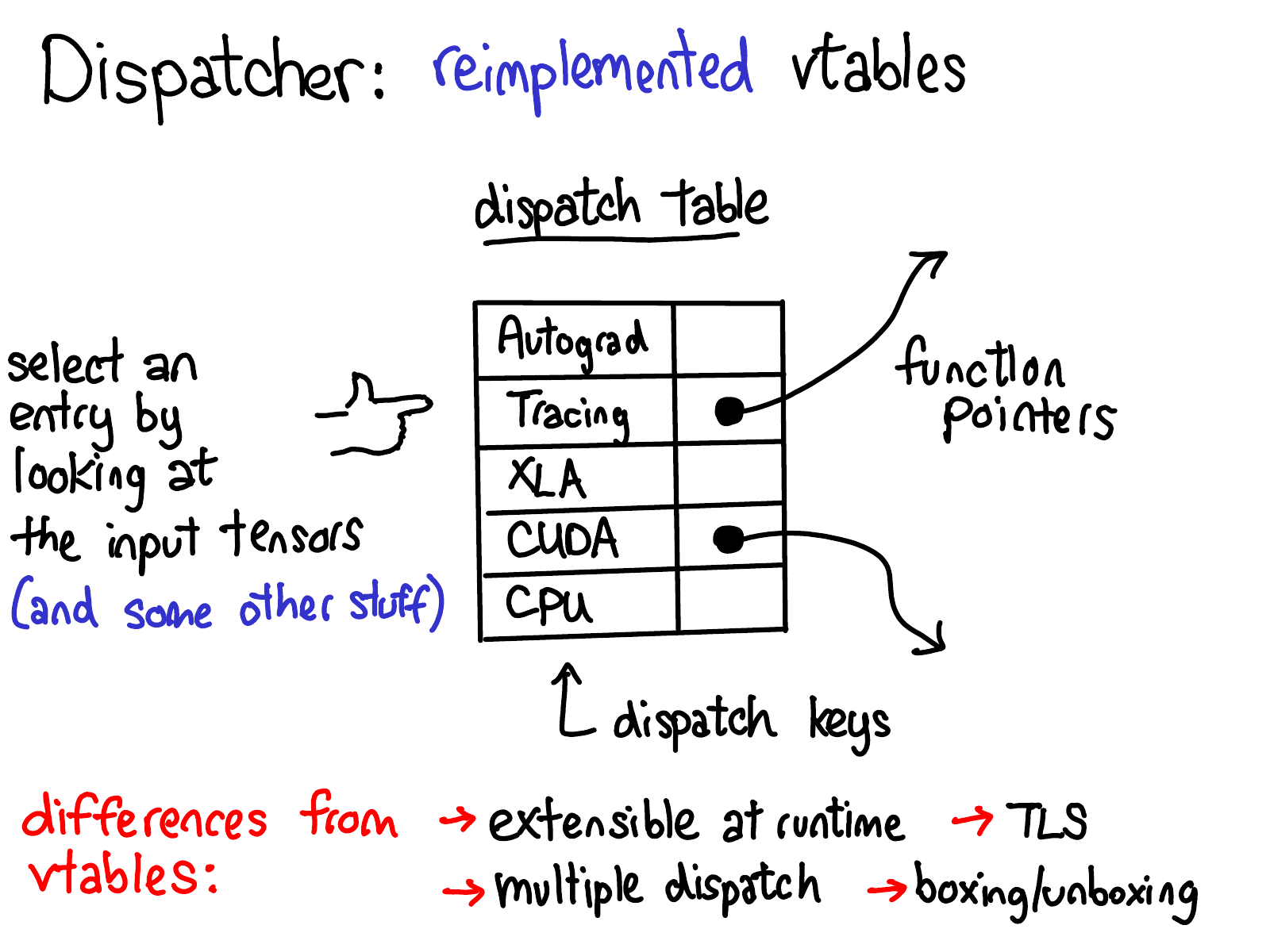
Yang (2020): The dispatch table. Each operator (row) has one slot per dispatch key (column). A cell contains a function pointer when a kernel has been registered for that (operator, key) pair, and is null otherwise. The dispatcher selects the highest-priority non-null cell for the current call.
1.7 Cross-Cutting Concerns as First-Class Citizens
The key design insight is that features like autograd, tracing, and functionalization are expressed as additional dispatch keys, not as an additional class hierarchy. Each such key registers a fallback kernel that intercepts any operator call, performs its cross-cutting work, and then calls redispatch to continue down the priority stack to the next key.
This means adding a new cross-cutting feature requires:
1. Defining a new DispatchKey enum value.
2. Registering one fallback kernel for that key — once, for all operators.
3. Zero changes to existing backend kernels.
Compare to the VariableType approach: instead of ~600 autograd wrappers (one per operator), the autograd fallback is a single boxed kernel that intercepts all operators via the boxed calling convention, performs gradient bookkeeping generically using the operator’s registered derivative formula, and redispatches. The per-operator gradient formulas live in derivatives.yaml — not in per-operator C++ wrapper functions.
2. Dispatch Keys and DispatchKeySet ⚙️
2.1 DispatchKey: the Enum
Definition (DispatchKey). A DispatchKey is a named constant from an enum (defined in c10/core/DispatchKey.h) identifying either a backend (a physical compute substrate) or a cross-cutting concern (a behavioral modifier applied before/after the backend kernel). Representative values:
| Category | Keys |
|---|---|
| Hardware backends | CPU, CUDA, MPS, XLA, Meta, Lazy |
| Per-backend autograd | AutogradCPU, AutogradCUDA, AutogradXLA, … |
| Alias: all autograd backends | Autograd (expands to all Autograd* keys at registration) |
| Factory / device selection | BackendSelect |
| Python interop | Python (called PythonKey in user-facing docs) |
| Functional transforms | Functionalize |
| Tracing | Tracer |
| Composite aliases | CompositeImplicitAutograd, CompositeExplicitAutograd |
| Functional transforms (functorch) | FuncTorchGradWrapper, FuncTorchBatched, FuncTorchVmapMode |
The enum is organized so that higher-numbered keys have higher priority. The dispatcher uses the most-significant-bit position of the DispatchKeySet bitmask to resolve ties.
2.2 DispatchKeySet: the 64-Bit Bitmask
Definition (DispatchKeySet). A DispatchKeySet is a uint64_t where each bit corresponds to one DispatchKey. Bit \(i\) is set if and only if key \(i\) is active. The set supports standard bitwise operations: union (|), intersection (&), complement (~), and difference (&~).
Internally, the 64 bits are split into two regions:
\[\underbrace{\text{high bits}}_{\text{functionality keys (Autograd, Functionalize, ...)}} \;|\; \underbrace{\text{low bits}}_{\text{backend component keys (CPU, CUDA, ...)}}\]
The lower ~12 bits encode the backend component (CPU, CUDA, MPS, etc.); the remaining upper bits encode functionality keys. A runtime key for a per-backend functionality (e.g. AutogradCUDA) is computed by combining the functionality bit with the backend bit at dispatch time via toRuntimePerBackendFunctionalityKey(functionality, backend).
Definition (highest-priority key extraction). The dispatcher finds the highest-priority active key by locating the most-significant set bit in the uint64_t:
// From c10/core/DispatchKeySet.h
DispatchKey highestPriorityTypeId() const {
    auto functionality = highestFunctionalityKey();
    if (isPerBackendFunctionality(functionality)) {
        return toRuntimePerBackendFunctionalityKey(
            functionality, highestBackendKey());
    }
    return functionality;
}
The function highestFunctionalityKey() calls countLeadingZeros on the repr_ field — a single hardware instruction on modern CPUs — making key resolution \(O(1)\).
2.3 Priority Ordering
The priority ordering from high to low (highest fires first) is approximately:
FuncTorchDynamicLayerFrontMode  (outermost functorch transform)
FuncTorchGradWrapper            (grad() transform)
FuncTorchVmapMode               (vmap() transform)
Python                          (__torch_dispatch__)
Functionalize                   (AOTAutograd functional transform)
AutogradCUDA / AutogradCPU      (per-backend autograd wrappers)
Autograd                        (alias: all per-backend autograd keys)
BackendSelect                   (device selection for factory ops)
CUDA / CPU / MPS / XLA / ...    (actual backend computation)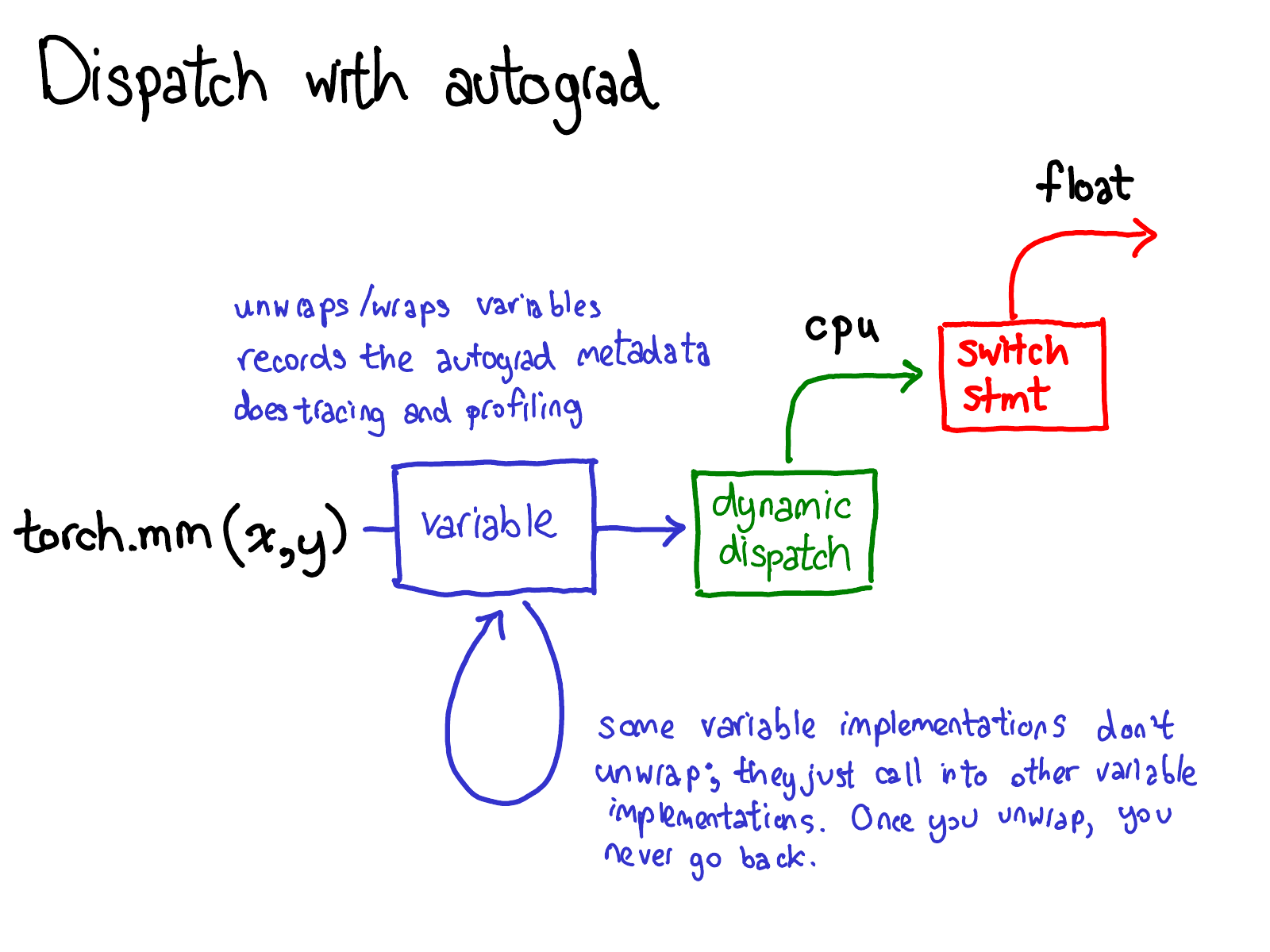
Yang (2019): Visual depiction of the dispatch key priority order. Keys toward the top fire first; each key’s kernel typically calls redispatch to continue down the stack.
Important: CompositeImplicitAutograd and CompositeExplicitAutograd are alias keys used only at registration time. They are expanded to fill multiple concrete key slots (all backend keys, and the composite keys) when the operator is registered. They do not appear as bits in a runtime DispatchKeySet.
2.4 Computing the Keyset at Runtime
At every operator call site, the dispatcher builds the current DispatchKeySet as:
\[\text{keyset} = \Bigl(\bigcup_{t \in \text{tensor args}} \text{key\_set}(t)\Bigr) \cup \text{TLS}_{\text{include}} \cup \text{global} \;\setminus\; \text{TLS}_{\text{exclude}}\]
The four components are:
| Component | Source | Example |
|---|---|---|
| \(\bigcup \text{key\_set}(t)\) | Tensor arguments | AutogradCUDA | CUDA for a CUDA tensor with requires_grad=True |
| \(\text{TLS}_{\text{include}}\) | Thread-local include set | Tracer when inside torch.jit.trace |
| \(\text{global}\) | Always-on global keys | BackendSelect, ADInplaceOrView |
| \(\text{TLS}_{\text{exclude}}\) | Thread-local exclude set | AutogradCUDA when inside torch.no_grad() or after an Autograd kernel has run |
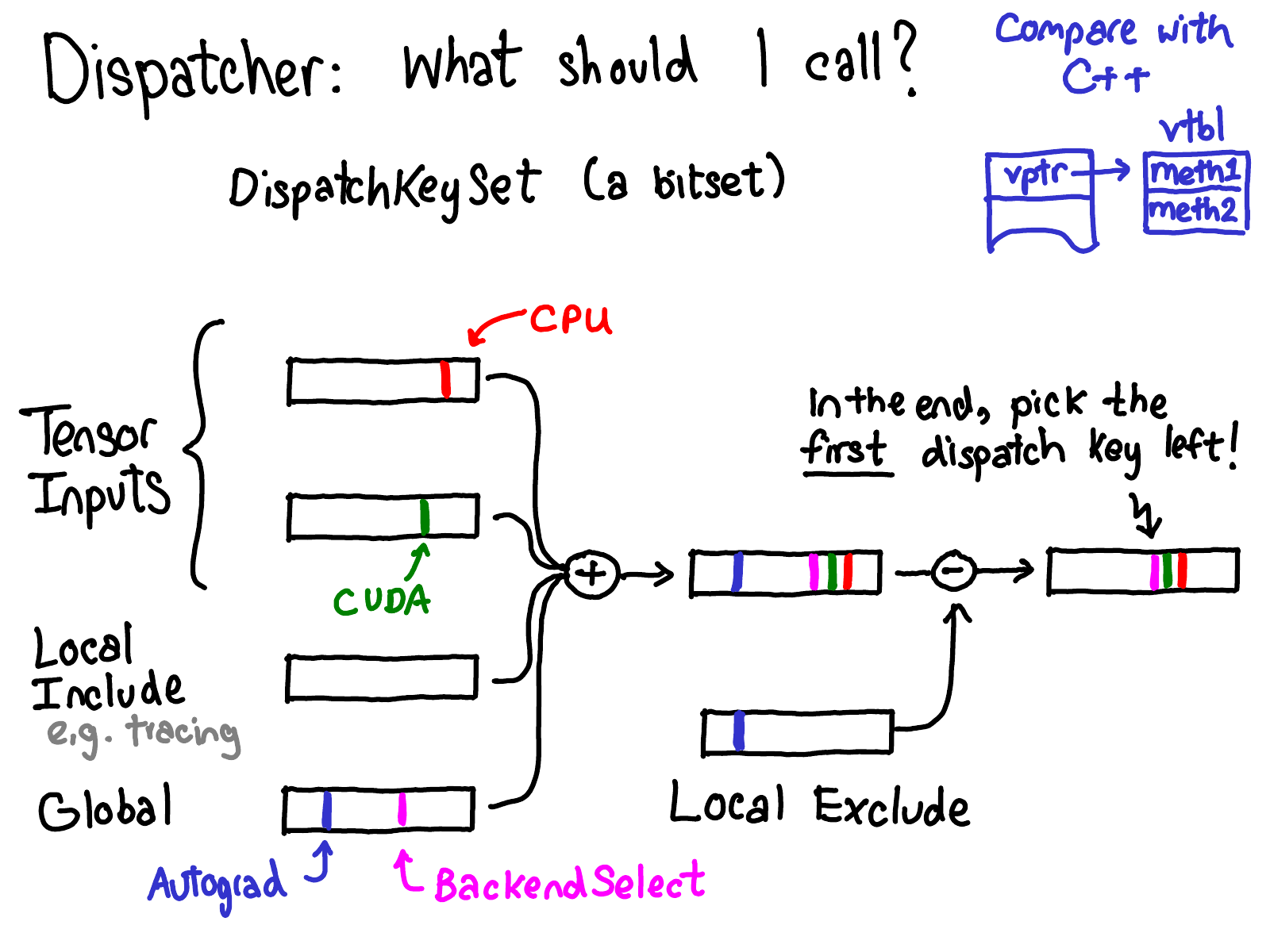
Yang (2020): How the DispatchKeySet is assembled. All four sources are combined with bitwise OR, then the TLS exclude set is subtracted with & ~exclude. The resulting bitmask is the one whose highest set bit selects the kernel.
2.5 Toy Python Implementation
from __future__ import annotations
from enum import IntEnum

class DispatchKey(IntEnum):
    CPU              = 1
    CUDA             = 2
    AutogradCPU      = 10
    AutogradCUDA     = 11
    Functionalize    = 20
    Python           = 30
    BackendSelect    = 5

class DispatchKeySet:
    def __init__(self, *keys: DispatchKey):
        self._bits: int = 0
        for k in keys:
            self._bits |= (1 << int(k))

    def __or__(self, other: DispatchKeySet) -> DispatchKeySet:
        result = DispatchKeySet()
        result._bits = self._bits | other._bits
        return result

    def __and__(self, mask: DispatchKeySet) -> DispatchKeySet:
        result = DispatchKeySet()
        result._bits = self._bits & mask._bits
        return result

    def exclude(self, other: DispatchKeySet) -> DispatchKeySet:
        result = DispatchKeySet()
        result._bits = self._bits & ~other._bits
        return result

    def highest_priority_key(self) -> DispatchKey | None:
        if self._bits == 0:
            return None
        msb_index = self._bits.bit_length() - 1
        return DispatchKey(msb_index)

    def has(self, key: DispatchKey) -> bool:
        return bool(self._bits & (1 << int(key)))

    def __repr__(self) -> str:
        active = [k.name for k in DispatchKey if self.has(k)]
        return f"DispatchKeySet({{{', '.join(active)}}})"


def compute_keyset(
    tensor_keysets: list[DispatchKeySet],
    tls_include: DispatchKeySet,
    tls_exclude: DispatchKeySet,
    global_set: DispatchKeySet,
) -> DispatchKeySet:
    combined = global_set | tls_include
    for ks in tensor_keysets:
        combined = combined | ks
    return combined.exclude(tls_exclude)


cuda_tensor_ks = DispatchKeySet(DispatchKey.AutogradCUDA, DispatchKey.CUDA)
global_ks = DispatchKeySet(DispatchKey.BackendSelect)
tls_include = DispatchKeySet()
tls_exclude = DispatchKeySet()

keyset = compute_keyset([cuda_tensor_ks], tls_include, tls_exclude, global_ks)
print(keyset)
print("Highest:", keyset.highest_priority_key())
Running this prints:
DispatchKeySet({CUDA, BackendSelect, AutogradCUDA})
Highest: AutogradCUDA
The bit_length() - 1 trick finds the most-significant set bit in \(O(1)\), mirroring countLeadingZeros in the C++ implementation.
This problem establishes how the Autograd key is masked out after it fires.
Prerequisites: 2.4 Computing the Keyset at Runtime, 2.5 Toy Python Implementation
Using the DispatchKeySet class above, write a function after_autograd(keyset) that returns the keyset that would be used after the AutogradCUDA kernel has fired — that is, the keyset passed to redispatch. Then call it on the keyset computed above and verify the new highest-priority key is CUDA.
Key insight: The Autograd kernel adds AutogradCUDA (and all other autograd keys) to the thread-local exclude set before calling redispatch. We simulate this with exclude.
Sketch:
autograd_keys = DispatchKeySet(DispatchKey.AutogradCUDA, DispatchKey.AutogradCPU)

def after_autograd(keyset: DispatchKeySet) -> DispatchKeySet:
    return keyset.exclude(autograd_keys)

reduced = after_autograd(keyset)
print(reduced)
print("Highest after autograd:", reduced.highest_priority_key())
Output: DispatchKeySet({CUDA, BackendSelect}) and Highest after autograd: BackendSelect. Since BackendSelect is a fallthrough (no kernel registered for add), it skips immediately to CUDA.
3. The Dispatch Table 📋
3.1 OperatorHandle
Definition (OperatorHandle). For each registered operator, the dispatcher allocates one OperatorHandle object on the heap (via std::list to ensure stable addresses). The OperatorHandle contains:
- The operator’s schema (a
FunctionSchemaobject holding the operator name, overload name, argument types, return types, and aliasing annotations). - A fixed-size dispatch table: an array
dispatch_table_indexed byDispatchKeyenum value, each cell holding aKernelFunction. - A
std::list<AnnotatedKernel>for each key, preserving registration history.
Definition (KernelFunction). A KernelFunction stores a pair: an optional unboxed function pointer (type-erased as void* but cast to the correct signature at call time) and a mandatory boxed function pointer (always present; used as fallback when no unboxed pointer is available). When a kernel is registered as unboxed, the dispatcher also auto-generates and stores its boxed wrapper.
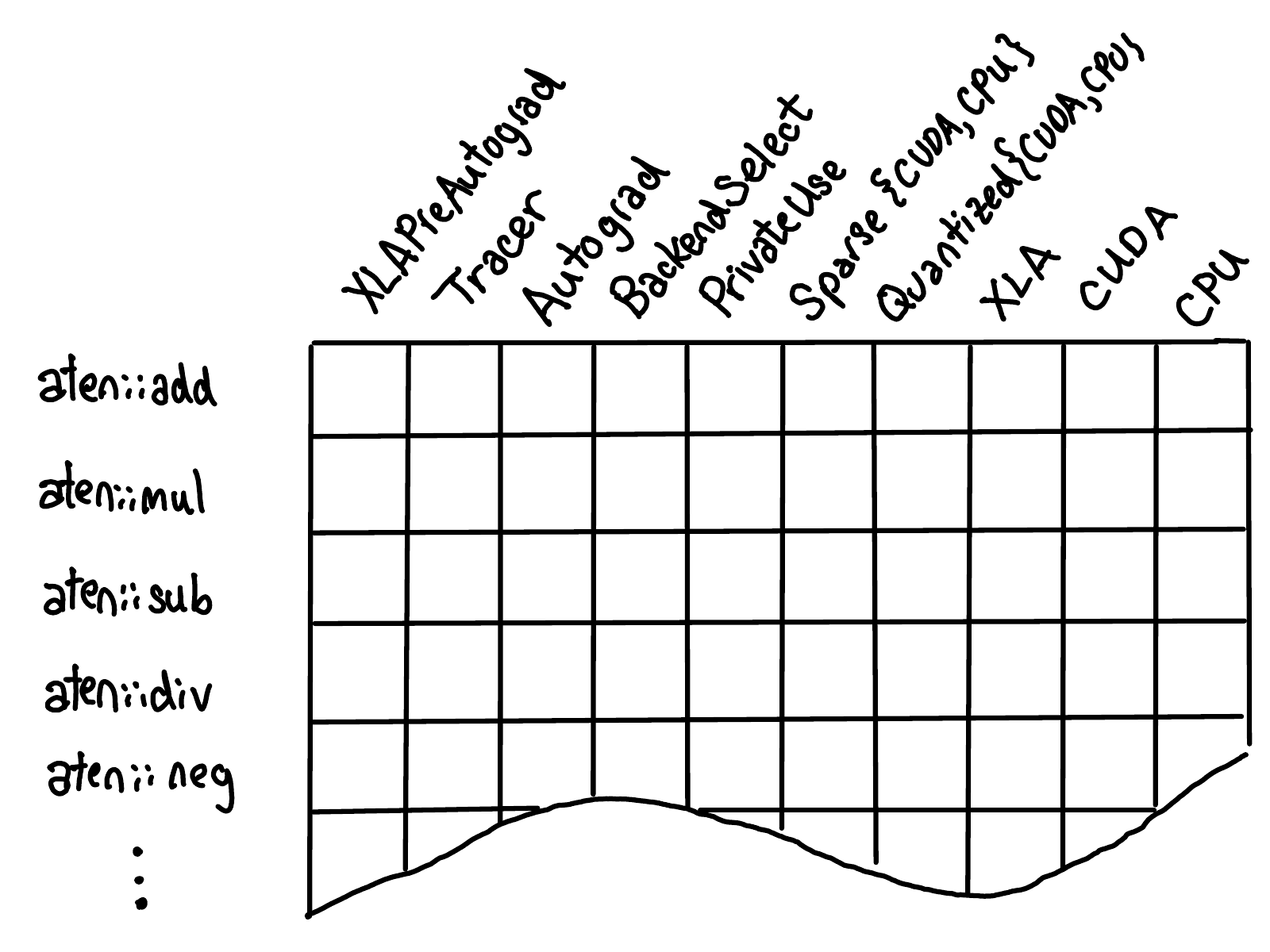
Yang (2020): The full dispatch table grid. Rows are operators; columns are dispatch keys. Most cells are empty (no kernel). Composite keys fill entire rows. Backend-specific kernels fill individual cells. The shading distinguishes exact registrations, catch-all registrations, and backend fallbacks.
3.2 Kernel Lookup
Given a DispatchKeySet, the lookup proceeds in two steps:
- Extract key:
key = keyset.highestPriorityTypeId()— the \(O(1)\) MSB extraction described in §2.2. - Index table:
kernel = dispatch_table_[static_cast<uint8_t>(key)].
If the cell is non-null, the kernel is called. If null, the dispatcher advances to the next key by removing key from the keyset and repeating — this is called falling through.
In practice, the dispatcher does not loop linearly. It precomputes a dispatch table with all fallthrough chains resolved. computeDispatchTableEntryWithNoFallthrough propagates fallthrough pointers at registration time so the hot dispatch path is always a single array lookup.
3.3 Three Registration Slots
For any given (operator, dispatch key) pair, there are three levels of registration, resolved in this order of precedence:
| Slot | How registered | Scope | Priority |
|---|---|---|---|
| Exact kernel | m.impl("op", key, fn) |
One operator × one key | Highest |
| Backend fallback | m.fallback(key, fn) (column-wise) |
One key × all operators | Middle |
| Catch-all | m.impl("op", DispatchKey::CompositeImplicitAutograd, fn) |
One operator × all keys | Lowest |
Exact kernels have the highest priority: if an op has both a CUDA exact kernel and a CompositeImplicitAutograd catch-all, the CUDA kernel wins for CUDA tensors.
Backend fallbacks fill an entire column: registering a profiling fallback at Profiler means every operator will be intercepted by the profiler on every call, regardless of whether an exact profiling kernel was registered.
Catch-all (composite) registrations fill an entire row: a CompositeImplicitAutograd kernel claims all backend slots simultaneously, expressing “this operator decomposes into primitives regardless of backend.”
This problem establishes how registration priority interacts with the dispatch table.
Prerequisites: 3.3 Three Registration Slots
Suppose aten::special_op is registered with a CompositeImplicitAutograd kernel that decomposes into aten::add and aten::mul. Later, a custom CUDA backend registers an exact kernel at CUDA for special_op. For a CUDA tensor with requires_grad=True, list in order all the dispatch keys that will fire when special_op(x) is called, and which kernel runs at each.
Key insight: Exact registrations override composite catch-alls for their specific key. The AutogradCUDA slot for special_op is inherited from the composite decomposition (since no Autograd exact kernel was explicitly registered), so it fires first.
Sketch:
1. AutogradCUDA fires: the autograd wrapper (from the composite decomposition via CompositeImplicitAutograd) saves inputs, constructs a grad_fn, calls redispatch excluding autograd keys.
2. CUDA fires: the exact custom CUDA kernel registered for special_op — not the composite decomposition. This is the key point: even though CompositeImplicitAutograd filled the row, the explicit CUDA registration overwrites that cell.
If no exact CUDA kernel had been registered, step 2 would instead execute the composite decomposition’s add + mul chain, each of which dispatches independently through the full pipeline.
4. Operator Registration 🔧
4.1 TORCH_LIBRARY and TORCH_LIBRARY_IMPL
Registration in C++ uses two macros:
TORCH_LIBRARY(ns, m) — declares a namespace and registers schemas (the operator signature contract). No kernel is specified here; only the type contract.
TORCH_LIBRARY(myops, m) {
    m.def("add_scaled(Tensor self, Tensor other, float scale) -> Tensor");
}
TORCH_LIBRARY_IMPL(ns, key, m) — registers a kernel for a specific dispatch key. Multiple IMPL blocks can exist for the same namespace, one per key.
TORCH_LIBRARY_IMPL(myops, CPU, m) {
    m.impl("add_scaled", add_scaled_cpu);
}

TORCH_LIBRARY_IMPL(myops, CUDA, m) {
    m.impl("add_scaled", add_scaled_cuda);
}

TORCH_LIBRARY_IMPL(myops, Autograd, m) {
    m.impl("add_scaled", torch::autograd::autogradNotImplementedFallback());
}
The TORCH_LIBRARY blocks are processed at static initialization time (before main()). The Dispatcher::singleton() object accumulates all registrations and computes the dispatch table entries lazily or eagerly depending on when they arrive.
4.2 native_functions.yaml and Codegen
Built-in ATen operators are declared in aten/src/ATen/native/native_functions.yaml. This YAML file is the source of truth for the operator contract. Each entry has the form:
- func: add.Tensor(Tensor self, Tensor other, *, Scalar alpha=1) -> Tensor
  variants: function, method
  dispatch:
    CPU: add_cpu
    CUDA: add_cuda
    SparseCPU: add_sparse_cpu
    SparseCUDA: add_sparse_cuda
    CompositeImplicitAutograd: add
The dispatch: block maps DispatchKey names to the C++ function name implementing that key. The codegen step (invoked at build time by torchgen) reads this YAML and generates:
| Generated artifact | Purpose |
|---|---|
Functions.h, Operators.h |
C++ API headers (at::add(...)) |
RegisterCPU.cpp, RegisterCUDA.cpp |
TORCH_LIBRARY_IMPL blocks that wire YAML entries to C++ functions |
VariableType_*.cpp |
Autograd wrapper functions for each op |
torch/csrc/autograd/generated/python_variable_methods.cpp |
Python torch.* and Tensor.* bindings (the THPVariable_add layer) |
The variants: function, method field controls whether torch.add(x, y) and x.add(y) are both generated. The aliasing annotation Tensor(a!) in the schema tells the compiler that the argument is written in place, allowing alias analysis downstream.
Dispatch keywords recognized in the YAML:
| Keyword | Meaning |
|---|---|
CPU, CUDA, MPS, XLA, … |
Exact per-backend kernel |
CompositeImplicitAutograd |
Decomposition into primitives; autograd inherited |
CompositeExplicitAutograd |
Decomposition with a separately registered autograd formula |
CompositeExplicitAutogradNonFunctional |
Decomposition that uses aliasing ops internally |
Meta |
Abstract (“fake”) kernel for shape inference without data |
4.3 Unboxed and Boxed Registration
m.impl("op_name", fn) registers fn as an unboxed kernel: fn is a typed C++ function pointer (or lambda) whose signature matches the operator schema exactly. The dispatcher stores it as-is and also auto-generates a boxed wrapper that packs/unpacks IValue arguments.
m.impl("op_name", torch::CppFunction::makeFromBoxedFunction(&my_boxed_kernel)) registers a boxed kernel: my_boxed_kernel has the signature void(const OperatorHandle&, DispatchKeySet, Stack*). It receives type-erased arguments and must manually unpack them. This is used for fallback kernels that must work for all operators without knowing their signatures.
4.4 Example: Registering a Custom Op
#include <torch/library.h>
#include <ATen/ATen.h>

at::Tensor add_scaled_cpu(const at::Tensor& a, const at::Tensor& b, double s) {
    return (a + b) * s;
}

at::Tensor add_scaled_cuda(const at::Tensor& a, const at::Tensor& b, double s) {
    return (a + b) * s;
}

class AddScaledBackward : public torch::autograd::Function<AddScaledBackward> {
public:
    static at::Tensor forward(
        torch::autograd::AutogradContext* ctx,
        const at::Tensor& a,
        const at::Tensor& b,
        double s)
    {
        ctx->saved_data["scale"] = s;
        return add_scaled_cpu(a, b, s);
    }

    static torch::autograd::tensor_list backward(
        torch::autograd::AutogradContext* ctx,
        torch::autograd::tensor_list grad_outputs)
    {
        double s = ctx->saved_data["scale"].toDouble();
        auto g = grad_outputs[0] * s;
        return {g, g, at::Tensor{}};
    }
};

TORCH_LIBRARY(myops, m) {
    m.def("add_scaled(Tensor a, Tensor b, float s) -> Tensor");
}

TORCH_LIBRARY_IMPL(myops, CPU, m) {
    m.impl("add_scaled", add_scaled_cpu);
}

TORCH_LIBRARY_IMPL(myops, CUDA, m) {
    m.impl("add_scaled", add_scaled_cuda);
}

TORCH_LIBRARY_IMPL(myops, Autograd, m) {
    m.impl("add_scaled", torch::autograd::autogradFunctionFallback<AddScaledBackward>());
}TORCH_LIBRARY and TORCH_LIBRARY_IMPL both execute at static initialization time. If a kernel is registered in a shared library that is loaded after the dispatcher has already processed some calls, the dispatch table must be updated retroactively. This is why the dispatcher stores registrations in a std::list rather than a flat array — insertions do not invalidate existing iterators.
This problem establishes when schema validation catches misregistrations.
Prerequisites: 4.1 TORCH_LIBRARY and TORCH_LIBRARY_IMPL
The schema "add_scaled(Tensor a, Tensor b, float s) -> Tensor" declares s as float. A C++ function add_scaled_cpu(const at::Tensor& a, const at::Tensor& b, double s) is registered. Will this cause an error? If so, at what point (compile time, registration time, or call time)?
Key insight: The dispatcher validates that the registered kernel’s C++ type signature matches the schema’s type contract at registration time using template metaprogramming (type traits that compare the C++ types against the schema’s ArgumentType list).
Sketch: In PyTorch’s dispatcher, float in a schema corresponds to double in C++ (PyTorch uses double internally for float scalars). So this specific case is actually fine — float in schema maps to double in C++. However, a genuine mismatch (e.g. registering int64_t where Tensor is expected) would be caught at m.impl(...) call time via a static assertion failure, not at kernel call time. The makeUnboxedOnlyFunctor template instantiation fails to compile if the types do not match.
5. Boxed vs. Unboxed Calling Convention 📦
5.1 Unboxed Convention
Definition (Unboxed Kernel). An unboxed kernel is a C++ function whose signature matches the operator schema exactly, with each schema type mapped to its canonical C++ type:
| Schema type | C++ type |
|---|---|
Tensor |
const at::Tensor& |
Tensor? |
const std::optional<at::Tensor>& |
int |
int64_t |
float |
double |
bool |
bool |
Scalar |
const at::Scalar& |
int[] |
at::IntArrayRef |
The dispatcher calls an unboxed kernel via a C++ function pointer cast — effectively a direct call instruction with no argument packing overhead. This is the calling convention for all built-in ATen kernels.
5.2 Boxed Convention and IValue
Definition (IValue). An IValue (short for interpreter value) is a tagged union that can hold any PyTorch value type. Internally it is a two-word struct: a payload word (holding the value or a pointer to heap-allocated data) and a tag word identifying the type. The possible tags include:
None, Tensor, Double, Int, Bool, String, Tuple, List,
GenericDict, Object, Capsule, RRef, Future, ...
Definition (Stack). A Stack is using Stack = std::vector<IValue>. Boxed kernels receive a Stack* and consume their arguments from the back of the stack, pushing their results back.
Definition (Boxed Kernel). A boxed kernel has the signature:
void boxed_kernel(const OperatorHandle& op, DispatchKeySet ks, Stack* stack);It receives a pointer to the current Stack, pops arguments in reverse order (last argument popped first), computes results, and pushes them. This convention allows a single kernel to work for any operator without knowing its signature at compile time.
5.3 Adapters: Boxing an Unboxed Kernel
When an unboxed kernel is registered, the dispatcher auto-generates a boxed wrapper via the template in aten/src/ATen/core/boxing/impl/make_boxed_from_unboxed_functor.h. The wrapper:
- Pops \(n\)
IValues from the stack. - Casts each to its corresponding C++ type (e.g.
ivalue.toTensor(),ivalue.toInt()). - Calls the unboxed function with those typed arguments.
- Pushes the result back as an
IValue.
This boxing path is only exercised when the boxed convention is needed (e.g. when a fallback kernel must re-invoke the operator). The hot path (eager Python and C++ calls) always takes the unboxed shortcut.
5.4 Why Fallbacks Need Boxing
A fallback kernel (registered column-wise for an entire dispatch key) must intercept any operator, but the operator’s argument types are not known at the time the fallback is written or compiled. The only way to write a single C++ function that handles aten::add(Tensor, Tensor, Scalar) and aten::convolution(Tensor, Tensor, Tensor?, int[], int[], int[], bool, int[], int) is through type erasure — hence boxing.
Surprisingly, the boxing overhead (stack allocation, IValue construction) is paid only by fallback paths. Normal eager execution of a built-in op always takes the unboxed path from the Python binding through to the kernel, incurring zero IValue allocations.
5.5 Boxed Fallback Kernels
Three important fallback kernels are implemented as boxed kernels:
CompositeImplicitAutograd — decomposes an operator into primitive ops that already have autograd formulas. Registered column-wise at the composite key. When an op’s YAML entry specifies CompositeImplicitAutograd: fn, the function fn is a plain C++ function that calls other ATen ops; it does not need an autograd formula because autograd flows through the inner ops’ grad_fn graphs automatically.
Functionalize — rewrites in-place mutations and aliasing view operations into functional (non-mutating, non-aliasing) equivalents. Used by AOTAutograd (see torch.compile) to convert a stateful eager program into a pure functional graph that can be differentiated and compiled. Implemented as a boxed fallback because it must intercept all operators, including user-defined custom ops.
PythonKey — calls back into Python when __torch_dispatch__ is active (see torch.fx). The boxed kernel packs all arguments into Python objects, calls the Python dispatch method, and unpacks the results. This is the mechanism underlying torch.fx.Interpreter, make_fx, and custom dispatch modes.
This problem establishes the overhead structure of the boxed calling convention.
Prerequisites: 5.2 Boxed Convention and IValue, 5.3 Adapters: Boxing an Unboxed Kernel
A fallback boxed kernel is registered for dispatch key Profiler. When aten::add(x, y) is called with two CUDA tensors, how many times (if any) are IValue objects constructed and destroyed over the full dispatch sequence: from the Python call, through the Profiler kernel, through AutogradCUDA, to the CUDA kernel?
Key insight: The boxed calling convention is exercised only when the fallback kernel is entered via the boxed path. But the hot path between Python and unboxed kernels does not construct IValue objects at all.
Sketch:
- Python → Dispatcher: zero IValue objects. The Python binding (THPVariable_add) unpacks Python objects directly into at::Tensor C++ objects and calls the typed C++ dispatcher API (Dispatcher::call<Tensor, Tensor, Tensor, Scalar>(...)).
- Dispatcher → Profiler boxed kernel: one set of IValue constructions (one per argument). The boxing adapter wraps x, y, and alpha into IValue objects on the Stack. The profiler kernel pops them, records timing, and re-pushes them (or calls redispatch with the same stack).
- Dispatcher → AutogradCUDA: if AutogradCUDA has an unboxed kernel (which it does — it is a generated C++ function), the arguments are unboxed back to at::Tensor for that call. One round-trip.
- AutogradCUDA → CUDA: the AutogradCUDA kernel itself calls redispatch via the unboxed API — zero additional IValue constructions.
- Total: one boxing (Python→Profiler) and one unboxing (Profiler→AutogradCUDA). All other transitions are unboxed.
6. Cross-Cutting Dispatch Keys in Depth 🔑
Yang (2020): The full operator × dispatch-key grid. Cross-cutting keys (Autograd, Functionalize, Python) span entire columns — each cell in a cross-cutting column contains the same fallback kernel. Backend keys (CPU, CUDA) have sparse coverage — only operators that have been explicitly implemented for that backend.
6.1 BackendSelect
Purpose: For factory functions (operators that create tensors rather than receiving them as input — e.g. torch.zeros, torch.randn), there are no tensor arguments from which to compute the backend bit. The DispatchKeySet from tensor arguments is empty. BackendSelect fires in this case.
Invariant: A BackendSelect kernel examines the device= keyword argument (or other hints like the TensorOptions struct) and determines the correct backend key, then calls redispatch with a keyset that includes the appropriate backend key but excludes BackendSelect.
When it fires: Always, for every operator call, because BackendSelect is in the global default include set. For non-factory ops, the BackendSelect cell contains a fallthrough pointer — it resolves immediately to the next key without doing any work.
6.2 Autograd and AutogradCUDA
Purpose: Constructs the autograd tape. For each differentiable op, a codegen’d wrapper (in VariableType_*.cpp) is registered at the per-backend autograd key (e.g. AutogradCUDA for CUDA ops). The Autograd alias key expands to all per-backend autograd keys at registration time.
Invariant: The autograd kernel must call redispatch with all autograd keys removed from the keyset before returning. Failure to do so causes infinite recursion because the same autograd kernel would fire again.
What it does:
def autograd_kernel_for_add(x, y, alpha=1):
    # 1. Check if any input requires grad
    any_requires_grad = x.requires_grad or y.requires_grad

    # 2. Enter no-grad scope for the actual computation (adds Autograd to TLS exclude)
    with torch.no_grad():
        # 3. Re-dispatch to CUDA kernel
        result = dispatcher.redispatch(keyset_without_autograd, "aten::add", x, y, alpha)

    # 4. If grad is needed, wrap result with grad_fn
    if any_requires_grad:
        result = set_history(result, AddBackward0(x, y, alpha))

    return result
The set_history call creates an AddBackward0 Node object, sets result.grad_fn to it, and records x and y as the saved inputs via collect_next_edges. See Autograd Engine for the Node/Edge DAG internals.
6.3 Functionalize
Purpose: Converts stateful (in-place, aliasing view) programs into functional programs that use only value-semantics ops. This is required by AOTAutograd to produce a clean computation graph for the compiler backend.
Invariant: Every in-place op op_ is replaced by out = op(copy_of_self); self.copy_(out) at the functional level. Every view op is replaced by as_strided with explicit stride arithmetic. The resulting graph has no aliasing, making it safe to reorder and fuse.
When it fires: Only when the Functionalize key is in the TLS include set — this key is not in the default global set. It is activated by torch._dispatch.python.enable_python_dispatcher() or internally by make_fx during AOTAutograd tracing.
6.4 PythonKey
Purpose: Calls back into Python when a __torch_dispatch__ handler is active. This is the low-level mechanism underlying torch.fx.Interpreter, make_fx, and custom tensor subclasses that intercept all ops.
Invariant: The Python dispatch key is activated by pushing a Python dispatch mode onto the thread-local mode stack (via _push_mode). The boxed kernel packs all tensor arguments and keyword arguments into Python objects, looks up __torch_dispatch__ on the mode, calls it, and unpacks the results.
When it fires: Whenever torch.overrides.enable_reentrant_dispatch() or any __torch_dispatch__ context is active. The Python key sits above Autograd in the priority ordering, so it fires before the autograd wrapper — this means __torch_dispatch__ sees the op before autograd has a chance to wrap the output. See torch.fx for how make_fx exploits this.
6.5 CompositeImplicitAutograd
Purpose: Registers an operator as a decomposition into more primitive ops. The term “Implicit” means the autograd formula is implicit — it is inherited automatically from the autograd formulas of the primitive ops in the decomposition.
Invariant: When aten::addmm is registered as CompositeImplicitAutograd, the kernel addmm decomposes into mm and add. Autograd for addmm is computed by differentiating through the mm and add ops, each of which has its own autograd formula. No explicit backward function is needed.
Effect on the dispatch table: Registering at CompositeImplicitAutograd fills the cells for all backend keys AND all autograd keys. An explicit backend registration (e.g. an optimized CUDA kernel for addmm) overrides the composite cell for that specific key.
Composite kernels can be problematic for torch.compile because the decomposition expands to more ops at trace time. For ops that should remain opaque to the compiler, CompositeExplicitAutograd or explicit per-backend registrations are preferred.
6.6 CompositeExplicitAutograd
Purpose: Like CompositeImplicitAutograd, but with an explicit hand-written autograd formula registered separately in derivatives.yaml. The decomposition is used for all backend computations, but the backward pass uses the custom formula rather than differentiating through the decomposition.
When to use: When the explicit formula is numerically superior to automatic differentiation through the decomposition — e.g. for log_softmax, where the naive backward through exp/sum/log is less numerically stable than a hand-derived formula.
This problem establishes when each composite key is appropriate.
Prerequisites: 6.5 CompositeImplicitAutograd, 6.6 CompositeExplicitAutograd
Operator aten::norm computes \(\|x\|_p = \left(\sum_i |x_i|^p\right)^{1/p}\). It decomposes into abs, pow, sum, pow. Should it be registered as CompositeImplicitAutograd or CompositeExplicitAutograd, and why? Would your answer change for \(p = 1\) vs. \(p = 2\)?
Key insight: CompositeImplicit is correct when automatic differentiation through the decomposition is numerically stable and efficient. CompositeExplicit is needed when the naive backward is numerically problematic.
Sketch: For general \(p\), the backward of \(\|x\|_p\) involves \(\partial/\partial x_i = \text{sgn}(x_i) \cdot |x_i|^{p-1} / \|x\|_p^{p-1}\). Differentiating through abs→pow→sum→pow produces this formula automatically, but with potential issues at \(x_i = 0\) for non-integer \(p\) (since pow(0, p-1) is indeterminate when \(p < 1\)). For \(p = 2\) (L2 norm), the formula simplifies to \(x / \|x\|_2\), which is well-behaved except at \(\|x\|_2 = 0\). In practice, PyTorch registers norm with CompositeImplicitAutograd but includes guards for the zero-norm degenerate case; a fully robust implementation would use CompositeExplicitAutograd with a numerically hardened backward.
7. Tracing the Full Call Stack for torch.add(x, y) 🔬
Let x and y be CUDA tensors with requires_grad=True. Here is the complete call stack from Python to the CUDA kernel and back.
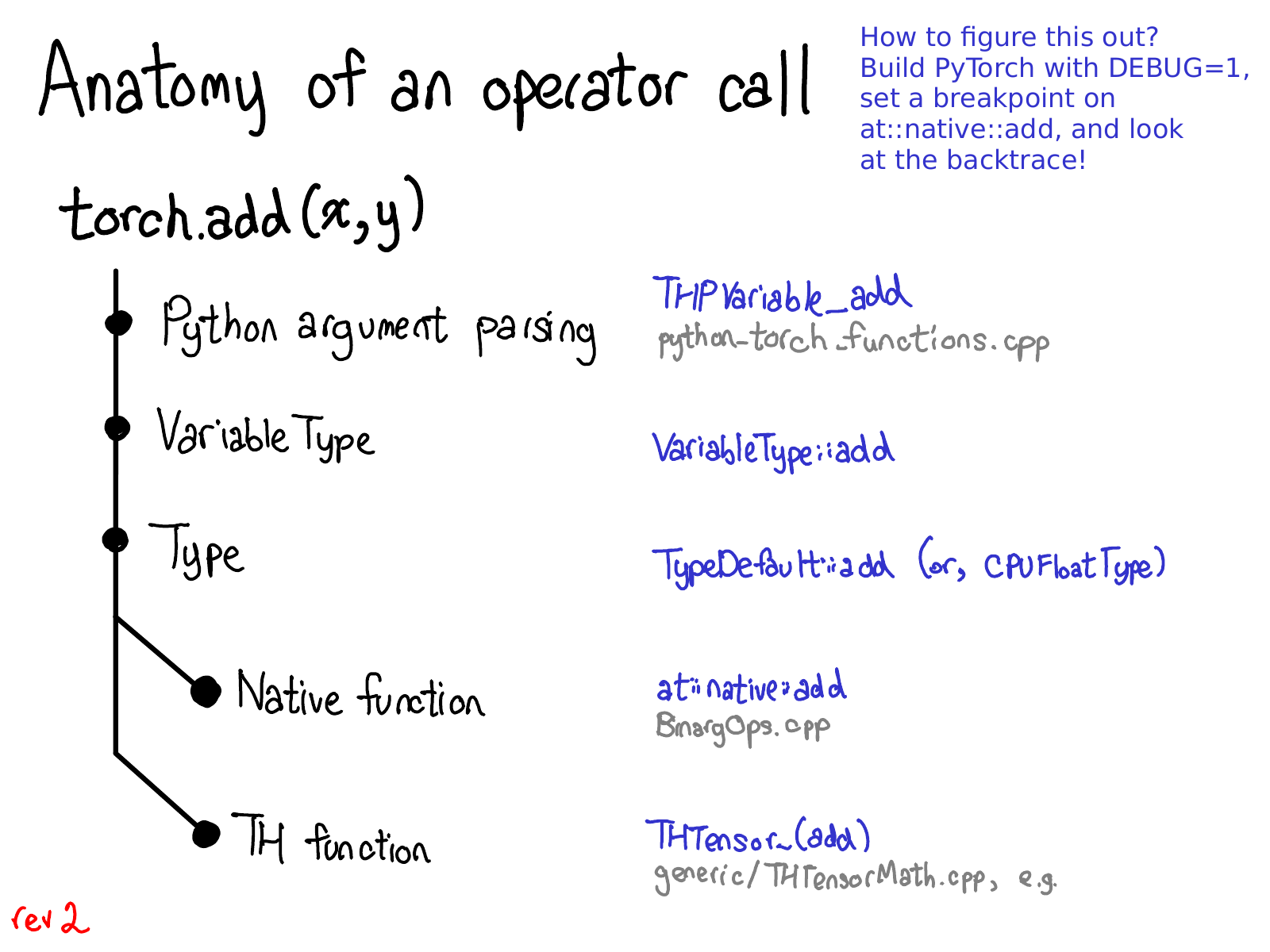
Yang (2019): The layered call chain for torch.add. Each layer is a separate dispatch key kernel; arrows represent function calls down (dispatch) and returns up (result propagation).
Step 1 — Python: torch.add(x, y)
The Python interpreter looks up torch.add, which resolves to THPVariable_add — a C function generated by torchgen from native_functions.yaml. THPVariable_add:
- Parses Python arguments using
PythonArgs(generated argument-parsing code). - Converts Python
Tensorobjects toat::TensorC++ objects. - Releases the GIL.
- Calls
at::_ops::add_Tensor::call(self, other, alpha).
Step 2 — ATen C++ API: at::_ops::add_Tensor::call
This is a thin generated wrapper that:
- Looks up the
OperatorHandleforaten::add.Tensorvia a static local variable (looked up once, cached for subsequent calls). - Computes the
DispatchKeySet:
\[\text{keyset} = \text{key\_set}(x) \cup \text{key\_set}(y) \cup \text{global} \setminus \text{TLS\_exclude}\]
For two CUDA tensors with requires_grad=True outside torch.no_grad():
\[\text{keyset} = \{\texttt{AutogradCUDA},\, \texttt{CUDA},\, \texttt{BackendSelect}\}\]
- Calls
Dispatcher::call(op_handle, keyset, self, other, alpha).
Step 3 — Dispatcher: kernel lookup
Dispatcher::call extracts the highest-priority key from keyset:
\[\text{key} = \texttt{highestPriorityTypeId}(\texttt{keyset}) = \texttt{AutogradCUDA}\]
It indexes dispatch_table_[AutogradCUDA] and retrieves the KernelFunction stored there — the codegen’d VariableType::add_Tensor function.
Step 4 — AutogradCUDA kernel: VariableType::add_Tensor (in VariableTypeEverything.cpp)
This is a generated function that:
- Checks
compute_requires_grad(self, other)— true here. - Creates an
AddBackward0node:
auto grad_fn = std::make_shared<AddBackward0>();
grad_fn->set_next_edges(collect_next_edges(self, other));
grad_fn->alpha = alpha;- Enters
AutoNonVariableTypeModeRAII guard — this addsAutogradCUDAtoTLS_exclude, preventing autograd from firing again. - Calls
Dispatcher::redispatch(keyset & ~autograd_keyset, op, self_base, other_base, alpha)— passes the originalkeysetwithAutogradCUDAmasked out. - Upon return, calls
set_history(result, grad_fn)— wraps the output tensor with theAddBackward0node.
Step 5 — Dispatcher redispatch: key lookup
With AutogradCUDA excluded, the new highest-priority key is:
\[\text{key} = \texttt{highestPriorityTypeId}(\texttt{keyset} \setminus \{\texttt{AutogradCUDA}\}) = \texttt{BackendSelect}\]
The BackendSelect cell for aten::add is a fallthrough (no factory-specific logic needed), so the dispatcher advances to the next key:
\[\text{key} = \texttt{CUDA}\]
Step 6 — CUDA kernel: at::native::add_cuda
The CUDA kernel:
- Is dispatched to via
dispatch_table_[CUDA]. - Constructs a
TensorIteratorto handle broadcasting, dtype promotion, and strided indexing. - Launches an elementwise CUDA kernel (a
gpu_kernelcall that dispatches over dtypes viaAT_DISPATCH_ALL_TYPES). - Returns the output tensor.
Step 7 — Return path
Control unwinds back through VariableType::add_Tensor, which calls set_history(result, grad_fn). The returned tensor has:
result.requires_grad() == Trueresult.grad_fn == AddBackward0_instanceAddBackward0_instance.next_edges_ == [Edge(x.grad_fn or AccumulateGrad), Edge(y.grad_fn or AccumulateGrad)]
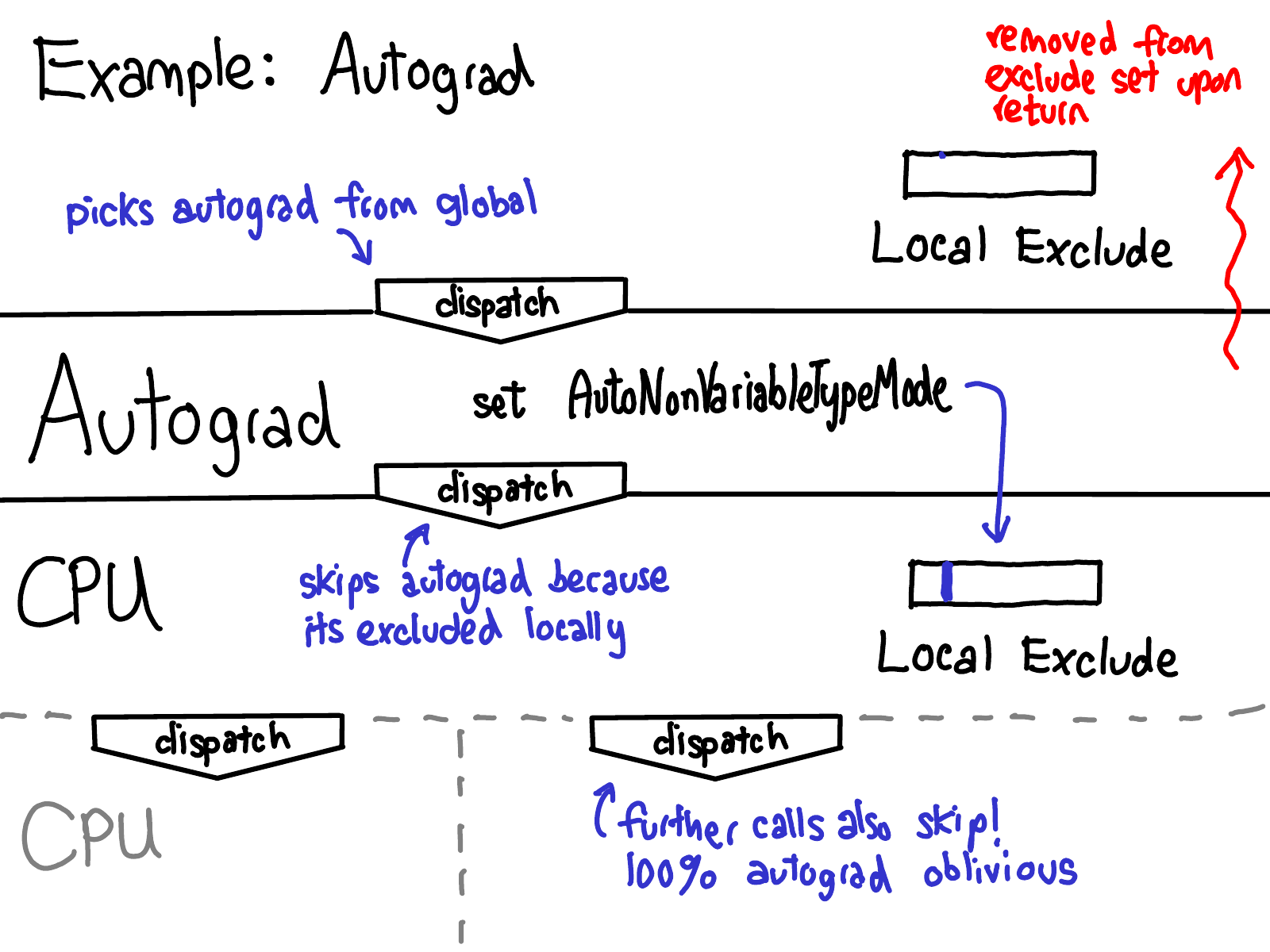
Yang (2020): The two-pass dispatch sequence. In the first pass the AutogradCUDA kernel fires, creates the AddBackward0 node, and calls redispatch. In the second pass (with AutogradCUDA excluded from the keyset) the CUDA kernel fires and performs the actual computation. The output tensor is wrapped with the grad_fn pointer only after the second pass completes.
This problem establishes how BackendSelect functions for a factory op with no tensor inputs.
Prerequisites: 7. Tracing the Full Call Stack for torch.add(x, y), 6.1 BackendSelect
Trace the dispatch sequence for torch.zeros(4, 8, device="cuda"). What is the DispatchKeySet computed by the dispatcher at Step 2? Which key fires first and why? What does the BackendSelect kernel do here, in contrast to the fallthrough it performs for torch.add?
Key insight: Factory ops have no tensor arguments, so the union over tensor argument keysets is empty. The only active keys come from the global default set.
Sketch:
- Step 2: keyset = {} | global = {BackendSelect}. There are no tensor arguments contributing AutogradCUDA or CUDA bits.
- Step 3: Highest-priority key is BackendSelect. The BackendSelect kernel for zeros is not a fallthrough — it is a real kernel that reads the TensorOptions argument (which carries device=cuda), extracts the DeviceType::CUDA value, and calls redispatch with a keyset that explicitly includes the CUDA backend key: redispatch({CUDA}, op, size, options_on_cuda).
- Step 5: Now keyset = {CUDA}, so the CUDA zeros kernel fires and allocates a zero-filled CUDA tensor via CUDACachingAllocator.
- No autograd key fires because requires_grad defaults to False for torch.zeros.
8. The redispatch Mechanism 🔄
8.1 Why Masking Rather Than a Direct Call
After the AutogradCUDA kernel has finished setting up the tape, it needs to invoke the actual computation kernel. It could do this via a direct C++ function call:
at::native::add_cuda(self, other, alpha); // direct call, bypassing dispatcherbut this is incorrect: it skips all intermediate dispatch keys that might sit between AutogradCUDA and CUDA. In a production deployment, the key sequence might be:
\[\texttt{AutogradCUDA} \to \texttt{Profiler} \to \texttt{Autocast} \to \texttt{CUDA}\]
A direct call would skip Profiler and Autocast. The dispatcher’s redispatch API avoids this:
at::redispatch::add(keyset & ~autograd_keyset, self, other, alpha);This passes the masked keyset back into the dispatcher, which selects the next highest-priority key with a registered kernel — whatever that happens to be.
The crucial property: the AutogradCUDA kernel does not need to know what keys exist between it and the backend. It only needs to mask itself out and re-enter the dispatcher. All other cross-cutting keys are handled transparently.
8.2 Guard-Based vs. Explicit redispatch
In practice, the masking is accomplished by a RAII guard rather than a manual keyset modification:
{
    at::AutoNonVariableTypeMode guard;
    // Everything inside this scope has AutogradCUDA in TLS_exclude.
    // Calls to any op will skip the Autograd key automatically.
    result = at::add(self_base, other_base, alpha);
}
AutoNonVariableTypeMode is a thin wrapper around DispatchKeySet::tls_set_dispatch_key_excluded(autograd_keys, true). When the guard is destroyed, the TLS exclude set is restored.
The explicit redispatch API is preferred in new code — it is more explicit about intent and avoids surprising interactions between nested guards.
Dispatcher::redispatch(keyset, op, args...)is equivalent to:
keyset_without_current = keyset & ~{currently_handled_key}
Dispatcher::call_with_keyset(keyset_without_current, op, args...)
Yang (2020): The redispatch flow. The AutogradCUDA kernel receives the full keyset, masks out AutogradCUDA, and hands the reduced keyset back to the dispatcher. The dispatcher then selects the next highest-priority key (here, CUDA) without any knowledge of what the AutogradCUDA kernel did.
This problem establishes that the redispatch mechanism handles arbitrary key compositions without any kernel knowing about each other.
Prerequisites: 8.1 Why Masking Rather Than a Direct Call, 8.2 Guard-Based vs. Explicit redispatch
Suppose a Profiler dispatch key is registered between AutogradCUDA and CUDA in the priority order. The Profiler boxed fallback kernel records timing and calls redispatch. For torch.add(x, y) with CUDA tensors and requires_grad=True, write the complete ordered list of (key, kernel) pairs that fire, with the keyset passed to each. Do the AutogradCUDA kernel and the CUDA kernel need to be modified to accommodate the Profiler?
Key insight: Neither the AutogradCUDA kernel nor the CUDA kernel needs any modification. The Profiler inserts itself purely by virtue of being in the priority order and registering a column-wide fallback.
Sketch:
| Step | Keyset passed in | Key selected | Kernel | Keyset for redispatch |
|---|---|---|---|---|
| 1 | {AutogradCUDA, Profiler, CUDA} |
AutogradCUDA |
VariableType::add_Tensor |
{Profiler, CUDA} |
| 2 | {Profiler, CUDA} |
Profiler |
profiler_fallback (boxed) |
{CUDA} |
| 3 | {CUDA} |
CUDA |
at::native::add_cuda |
— (returns) |
The AutogradCUDA kernel masks out autograd keys and calls redispatch({Profiler, CUDA}, ...). The dispatcher selects Profiler next — transparently. The CUDA kernel is called after the profiler records its timing. Neither AutogradCUDA nor CUDA is aware of the Profiler’s existence.
References
| Reference | Brief Summary | Link |
|---|---|---|
| Yang, “Let’s Talk About the PyTorch Dispatcher” (2020) | Three-part blog post covering dispatch key set computation, three-way registration taxonomy, and boxing/unboxing in depth. The primary reference for this note. | blog.ezyang.com |
| Yang, “PyTorch Internals” (2019) | Foundational tour of the tensor model, ATen dispatch, and the Python/C++ boundary. Background for the VariableType dispatch chain and AutogradMeta. |
blog.ezyang.com |
| PyTorch Dispatcher Walkthrough (PyTorch Wiki) | Step-by-step C++ call stack for torch.add() through dispatch-key-set resolution, AutoNonVariableTypeMode, and the CUDA kernel. |
github.com/pytorch/pytorch wiki |
| ATen native/README.md | native_functions.yaml schema reference: aliasing annotations, dispatch keywords, variant field, and codegen drivers. |
github.com |
| Registering a Dispatched Operator in C++ (PyTorch Docs) | Official tutorial for TORCH_LIBRARY / TORCH_LIBRARY_IMPL; boxed vs. unboxed registration; autograd integration for custom ops. |
docs.pytorch.org |
| Boxing and Unboxing in the PyTorch Operator Library (PyTorch Wiki) | Internal wiki covering IValue semantics, Stack-based calling convention, and how boxing adapters are generated from unboxed kernel types. | github.com/pytorch/pytorch wiki |
| c10/core/DispatchKey.h (PyTorch source) | Authoritative enum definition for all DispatchKey values and the bitmask layout comment explaining the functionality/backend bit split. |
github.com |
| c10/core/DispatchKeySet.h (PyTorch source) | DispatchKeySet struct: uint64_t repr_, highestPriorityTypeId(), TLS include/exclude computation, and countLeadingZeros MSB trick. |
github.com |
| PyTorch Call Stack Deep Dive (Red Hat Emerging Technologies, 2026) | Frame-by-frame trace of torch.logaddexp from Python through THPVariable_*, ATen API, VariableType, to BinaryOpsKernel; matches the torch.add structure. |
next.redhat.com |
| Ansel, Yang et al., “PyTorch 2” (arXiv 2304.01277, 2024) | Covers Functionalize and PythonKey in the context of AOTAutograd, make_fx, and the compiler stack. |
arxiv.org |