🔬 TorchDynamo: Deep Dive
Table of Contents
- 1. The Python Bytecode Model
- 2. InstructionTranslator: Symbolic Bytecode Execution
- 3. VariableTracker Taxonomy
- 4. Guard Generation and GuardBuilder
- 5. Graph Breaks: Mechanics and Implications
- 6. The Compilation Cache in Depth
- 7. Debugging and Observability
- References
1. The Python Bytecode Model
This section assumes familiarity with CPython internals at the level of code objects and the eval loop. The torch.compile survey covers Dynamo at a high level; this note goes significantly deeper.
1.1 CPython Code Objects and the Value Stack
Every Python function is compiled by CPython into a code object (PyCodeObject), a C struct containing:
| Field | Type | Meaning |
|---|---|---|
co_code |
bytes |
Sequence of 2-byte instruction words: (opcode, arg) |
co_consts |
tuple |
Literal constants embedded in the bytecode |
co_varnames |
tuple |
Names of local variables |
co_freevars |
tuple |
Names of closed-over variables |
co_filename, co_firstlineno |
metadata | Source location |
When CPython calls a function it allocates a frame (PyFrameObject) from the code object. The frame holds:
- Value stack — a fixed-size array of
PyObject*pointers. The program counter (f_lasti) and stack pointer (f_stacktop) track execution state. f_locals— a C array of local variable slots, indexed by position inco_varnames.- A pointer to the enclosing frame (
f_back) forming the call stack.
The eval loop (_PyEval_EvalFrameDefault) fetches one instruction at a time, dispatches to a switch/computed-goto block keyed on the opcode, and manipulates the value stack. For instance:
LOAD_FAST i— pushesf_locals[i]onto the stack.BINARY_ADD— pops two objects, callsPyNumber_Add, pushes the result.CALL_FUNCTION n— pops the top \(n+1\) stack slots (callee + \(n\) args), calls_PyObject_Call, pushes the return value.RETURN_VALUE— pops the stack top and returns it as the frame’s result.
Definition (Execution Frame). Formally, a frame \(F\) is the tuple \((C, \sigma, \text{pc}, \ell)\) where \(C\) is the code object, \(\sigma : \text{Varnames} \to \text{PyObject*}\) is the local variable store, \(\text{pc} \in [0, |C.\texttt{co\_code}|)\) is the instruction pointer, and \(\ell\) is the value stack.
1.2 PEP 523: The Frame-Eval API
PEP 523 (CPython 3.6+) added an eval_frame function pointer to PyInterpreterState. Before evaluating any frame, CPython checks:
// Simplified from CPython/ceval.c
if (tstate->interp->eval_frame != NULL) {
    return tstate->interp->eval_frame(tstate, frame, throwflag);
}
return _PyEval_EvalFrameDefault(tstate, frame, throwflag);
This gives any C extension the ability to intercept every function call and either handle it or delegate back to the default evaluator. Dynamo registers custom_eval_frame_shim (in torch/csrc/dynamo/eval_frame.c) as this hook.
Definition (Custom Frame Evaluator). A frame evaluator has the C signature:
\[ \texttt{eval\_fn}(\texttt{PyThreadState}^*, \texttt{PyFrameObject}^*, \texttt{int}) \to \texttt{PyObject}^* \]
The throwflag argument signals whether an exception is being propagated into the frame; Dynamo passes it through unchanged when falling back to the default evaluator.
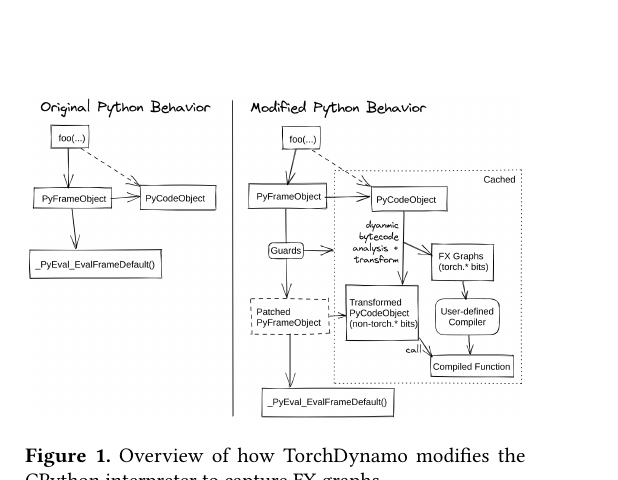
Ansel et al. (2024): TorchDynamo installs a custom frame-evaluation function via PEP 523. On the first call, it compiles the frame; on subsequent calls with passing guards, it swaps in the compiled code object directly.
1.3 Hook Installation via set_eval_frame
torch._dynamo.optimize and torch.compile ultimately call into torch/_dynamo/eval_frame.py, which wraps the C function set_eval_frame(callback). This function stores the callback in PyThreadState (thread-local), so the hook is per-thread, not global:
# Simplified from torch/_dynamo/eval_frame.py
@contextmanager
def enable_dynamo(compiler_fn):
    prior = set_eval_frame(compiler_fn)   # installs hook, returns old value
    try:
        yield
    finally:
set_eval_frame(prior) # restores previous hook (or None)Because the hook is stored in PyThreadState, separate Python threads each maintain their own hook. A thread that does not call set_eval_frame will not be intercepted by Dynamo, even if the main thread has an active hook. This makes torch.compile safe with Python threading but requires explicit handling in multi-threaded inference servers.
1.4 The Two Fast Paths
When custom_eval_frame_shim is invoked for a frame, it immediately checks the compilation cache attached to the frame’s code object:
flowchart TD
    A["Frame arrives at shim"]
    B["Iterate cache linked list"]
    C{"guard_fn check"}
    D["Swap code object
run compiled code
fast path 1: guard hit"]
    E["Call _compile_frame()
fast path 2: cache miss"]
    F["Append CacheEntry(guard_fn, compiled_code)"]
    G["Run compiled code"]

    A --> B --> C
    C -->|pass| D
    C -->|fail: all entries exhausted| E --> F --> G
Fast path 1 (guard hit): guard evaluation is pure Python predicate evaluation with no allocations. The compiled code object is swapped in and the default evaluator runs it — Dynamo is entirely out of the hot path.
Fast path 2 (cache miss): _compile_frame is called, which instantiates InstructionTranslator, performs symbolic execution, emits an FX graph, compiles it via the backend, generates a guard function, and appends a new CacheEntry to the linked list.
This problem tests understanding of where the PEP 523 hook is installed.
Prerequisites: 1.3 Hook Installation via set_eval_frame
Suppose you decorate a top-level function f with @torch.compile and call it from two threads simultaneously. Thread A calls f(x_A) and Thread B calls f(x_B) with different tensor dtypes. Describe precisely: (a) how many set_eval_frame calls occur and when; (b) whether the two threads share a compilation cache; (c) what happens if Thread B’s guard fails after Thread A has already compiled a specialization.
Key insight: The hook is stored per-thread in PyThreadState, but the compilation cache is stored on the code object (PyCodeObject), which is shared between threads.
Sketch:
(a) Each thread that enters the decorated function installs the hook via set_eval_frame independently — two calls, one per thread. The @torch.compile decorator wraps f in a OptimizedModule or equivalent that manages the context manager per-call.
The cache is shared: it lives on the code object
f.__code__, which is a single Python object referenced by both threads. Access to the linked list requires a GIL hold, so appending entries is safe but not lock-free.When Thread B’s guard fails, Dynamo is re-entered from Thread B’s context. It calls
_compile_frame, performs symbolic execution for Thread B’s dtype specialization, and appends a secondCacheEntry. The cache now has two entries. Future calls from either thread walk the list until a guard passes.
2. InstructionTranslator: Symbolic Bytecode Execution
2.1 The Symbolic Value Stack
InstructionTranslator (defined in torch/_dynamo/symbolic_convert.py) is a bytecode interpreter that re-executes the function’s bytecode symbolically rather than concretely. The key difference from CPython’s eval loop:
- CPython’s value stack holds
PyObject*— pointers to real Python objects. - Dynamo’s symbolic value stack holds
VariableTrackerinstances — abstract representations that carry both the object’s identity (for guard generation) and its FX proxy (for graph construction).
Definition (Symbolic Value Stack). The symbolic stack \(\hat{\ell}\) is a sequence of VariableTracker objects. Each tracker \(v \in \hat{\ell}\) carries:
1. A source annotation — a path expression describing how to reach the underlying Python object from the frame locals (used by GuardBuilder).
2. Optionally, an fx_proxy — a torch.fx.Proxy node in the OutputGraph representing this value’s computation.
2.2 Opcode Dispatch
InstructionTranslator contains one method per CPython opcode (or inherits it from a base class). The dispatch loop:
# Simplified from symbolic_convert.py
def step(self):
    inst = self.instructions[self.instruction_pointer]
    self.instruction_pointer += 1
    handler = getattr(self, inst.opname, None)
    if handler:
        handler(inst)
    else:
        self.unimplemented(f"opcode {inst.opname}")
Key opcode handlers:
| Opcode | Handler behavior |
|---|---|
LOAD_FAST |
Look up inst.argval in the symbolic locals dict; push the corresponding VariableTracker |
LOAD_CONST |
Wrap the literal in a ConstantVariable; push it |
LOAD_GLOBAL |
Look up the name in the frame globals; wrap as TorchVariable, NNModuleVariable, or ConstantVariable depending on the object type |
BINARY_ADD |
Pop two trackers \(b\), \(a\); call a.__add__(tx, [b]); push the result tracker |
CALL_FUNCTION |
Pop callee + args; dispatch to callee tracker’s call_function(tx, args, kwargs) |
RETURN_VALUE |
Pop the top-of-stack tracker; finalize OutputGraph; emit the compiled code |
POP_JUMP_IF_FALSE |
If the condition tracker is a ConstantVariable, specialize the branch. If it is a TensorVariable or SymNodeVariable, trigger a graph break. |
When POP_JUMP_IF_FALSE or POP_JUMP_IF_TRUE encounters a condition that is a TensorVariable, Dynamo cannot statically determine which branch to take — it triggers a graph break. This is the most common cause of fragmentation in models with dynamic control flow.
2.3 OutputGraph: FX Node Accumulation
OutputGraph (in torch/_dynamo/output_graph.py) is the accumulator that builds the torch.fx graph incrementally as InstructionTranslator processes instructions. It wraps an fx.Graph and exposes three primary emission methods:
Definition (FX Node Emission). During symbolic execution, OutputGraph emits nodes of three kinds:
| Kind | Emitted when | FX node op |
|---|---|---|
call_function |
A TorchVariable or BuiltinVariable is called with tensor arguments |
graph.call_function(fn, args, kwargs) |
call_method |
A method is called on a TensorVariable (e.g., .relu(), .view()) |
graph.call_method(method_name, args, kwargs) |
call_module |
An NNModuleVariable is called |
graph.call_module(module_name, args, kwargs) |
Each emission returns an fx.Proxy object, which is wrapped in a new TensorVariable and pushed onto the symbolic stack. This is how tensor computations propagate through the symbolic interpreter without actually running the computation.
Consider y = torch.relu(x) where x is a local tensor. The instruction sequence is roughly:
1. LOAD_GLOBAL torch → pushes a TorchVariable wrapping the torch module
2. LOAD_ATTR relu → pushes a TorchVariable wrapping torch.relu
3. LOAD_FAST x → pushes the TensorVariable for x (with proxy %x)
4. CALL_FUNCTION 1 → calls TorchVariable(torch.relu).call_function(tx, [TensorVariable(%x)], {}) → emits %relu = call_function[target=torch.relu](args=(%x,)) → pushes TensorVariable(%relu)
5. STORE_FAST y → pops the tracker and binds it to y in the symbolic locals
2.4 Inlining: InliningInstructionTranslator
When the callee of a CALL_FUNCTION is a Python def that Dynamo can inline (i.e., not a graph-break-causing builtin), Dynamo does not emit a call_function node. Instead, it inlines the callee by spawning a child InliningInstructionTranslator:
flowchart TD
    P["Parent InstructionTranslator
sees CALL_FUNCTION targeting a Python def"]
    C["InliningInstructionTranslator (child)
shares same OutputGraph
receives args from parent's symbolic stack
executes callee bytecode symbolically"]
    R["Returns result VariableTracker
to parent stack"]

    P --> C --> R
Definition (Inlining). InliningInstructionTranslator is a subclass of InstructionTranslator that overrides RETURN_VALUE to return the top-of-stack tracker to the parent rather than finalizing the graph. It shares the parent’s OutputGraph, so any FX nodes emitted by the inlined function appear in the same graph fragment.
Inlining is critical for capturing helper functions, nn.functional calls that are implemented in Python, and user-defined utility functions that operate only on tensors. If inlining encounters an operation that would cause a graph break, the break propagates up to the parent.
This problem establishes when inlining succeeds and when it degrades to a graph break.
Prerequisites: 2.4 Inlining: InliningInstructionTranslator
Consider:
def helper(t):
    if t.shape[0] > 10:   # data-independent: shape is static
        return t * 2
    return t + 1

@torch.compile
def f(x):
return helper(x)- Does Dynamo inline
helper? (b) Does theifbranch cause a graph break? (c) Now replacet.shape[0]witht.item(). What happens?
Key insight: Static shape guards enable specialization of control flow; data escape (item()) forces a break.
Sketch:
(a) Yes — helper is a plain Python def with no C-extension or graph-break operations, so InliningInstructionTranslator handles it.
No.
t.shape[0]is an integer known at trace time (Dynamo specializes tensor shapes by default). TheConstantVariablerepresentingshape[0]is compared against10using aCOMPARE_OPinstruction, yielding anotherConstantVariable(True or False). Dynamo specializes the branch without a break, installing a shape guardL['x'].shape[0] > 10(or its negation).t.item()materializes a tensor value into Python — it is a data escape. Dynamo cannot know the value at trace time, so it triggers a graph break insidehelper. The partial graph up toitem()is compiled; the branch and remainder execute in eager mode.
3. VariableTracker Taxonomy
3.1 Design Principle
VariableTracker (base class in torch/_dynamo/variables/base.py) is the abstract representation of a Python value during symbolic execution. Every object that Dynamo encounters — tensors, integers, functions, modules, lists — is wrapped in an appropriate subclass. The subclass determines three things:
- What guards are installed when the value enters the symbolic stack (via
make_guards). - What FX node is emitted when an operation is performed on the value (via
call_function,__add__, etc.). - Whether a graph break occurs if the operation is unsupported.
VariableBuilder is the factory that constructs VariableTracker instances from real Python objects at frame entry, attaching source annotations.
3.2 Major Subtypes
| Subtype | Source file | Wraps | Guards installed | FX emission |
|---|---|---|---|---|
TensorVariable |
variables/tensor.py |
torch.Tensor |
TENSOR_MATCH: dtype, device, ndim, requires_grad, dispatch keys. Shape dims: EQUALS_MATCH (static) or SHAPE_ENV inequality (dynamic) |
call_function / call_method producing a proxy |
ConstantVariable |
variables/constant.py |
Python int, float, bool, str, None |
EQUALS_MATCH on the concrete value |
Inlined as an immediate argument — no FX node |
TorchVariable |
variables/torch.py |
torch.* functions and namespaces |
ID_MATCH on the function object id |
call_function with target = the function |
NNModuleVariable |
variables/nn_module.py |
nn.Module instance |
ID_MATCH on the module instance |
call_module with target = module name |
SymNodeVariable |
variables/tensor.py |
Symbolic integer from ShapeEnv |
SHAPE_ENV inequality constraint |
Used in index expressions and size computations |
UserDefinedObjectVariable |
variables/user_defined.py |
Arbitrary Python object | Opaque; attribute accesses may install HASATTR guards |
None — triggers graph break if tensor-producing |
ListVariable / TupleVariable |
variables/lists.py |
Python list / tuple of traceable values |
Per-element guards from each element’s tracker | Reconstructed as immediate args; no graph node for the container |
BuiltinVariable |
variables/builtin.py |
Python builtins (len, range, zip, …) |
ID_MATCH |
Depends: len(tensor) → call_function, range(n) → unrolled loop |
SymNodeVariable wraps a torch.SymInt — a symbolic integer produced by Symbolic Shapes’ ShapeEnv. When dynamic=True is passed to torch.compile, tensor dimension values are not specialized to concrete integers but instead become SymInt objects tracked by ShapeEnv. Guards on these dimensions are expressed as inequalities (e.g., \(s_0 \ge 1\)) rather than equality checks.
3.3 Worked Example: y = x + 1
Let x be a torch.float32 tensor of shape (3, 4) passed as a local variable. The bytecode for y = x + 1 (under CPython 3.11) is approximately:
LOAD_FAST   x          # push x
LOAD_CONST  1          # push 1
BINARY_OP   +          # pop 1, pop x; push result
STORE_FAST  y          # pop result; bind to y
Dynamo’s InstructionTranslator processes each instruction:
LOAD_FAST x→ look upxin the symbolic locals dict.VariableBuilderhas already wrapped the concrete tensor at frame entry: it callsTensorVariable.__init__, records sourceLocalSource("x"), and installs guards viaTENSOR_MATCH(checks dtype = float32, device = cpu/cuda, ndim = 2, shape = (3, 4) under static mode). TheTensorVariable(carrying FX proxy%x) is pushed onto \(\hat\ell\).LOAD_CONST 1→ the literal1is wrapped asConstantVariable(1)with guardEQUALS_MATCH. No source annotation needed (literals have no runtime address). Pushed onto \(\hat\ell\).BINARY_OP +→ popsConstantVariable(1)thenTensorVariable(%x). Dispatch:TensorVariable.__add__(tx, [ConstantVariable(1)]). The tensor variable’s__add__method:- Resolves that
1is a constant, so it can be passed directly as an FX argument. - Calls
OutputGraph.call_function(torch.Tensor.__add__, args=(%x, 1)). OutputGraphemits an FX node:%add = call_function[target=torch.Tensor.__add__](args=(%x, 1)).- Returns a new
TensorVariablecarrying proxy%add. Pushed onto \(\hat\ell\).
- Resolves that
STORE_FAST y→ popsTensorVariable(%add)and binds it toyin the symbolic locals.
The FX graph after tracing y = x + 1 contains exactly two nodes: a placeholder for x and a call_function for the add. The constant 1 is not a graph node — it is a literal embedded in the call_function args.
This problem works through the guards generated for the worked example.
Prerequisites: 3.3 Worked Example: y = x + 1
For the function f(x): return x + 1 compiled with torch.compile (static shapes), list every guard predicate that Dynamo installs, give its type from the guard taxonomy, and explain which of them would fire if f is called again with a float64 tensor of the same shape.
Key insight: TENSOR_MATCH is a compound guard; a dtype mismatch fires it immediately.
Sketch:
Guards installed on first call (shape (3,4), dtype float32, device cpu):
| Predicate | Guard type |
|---|---|
isinstance(L['x'], torch.Tensor) |
TENSOR_MATCH (type check) |
L['x'].dtype == torch.float32 |
TENSOR_MATCH (dtype) |
L['x'].device.type == 'cpu' |
TENSOR_MATCH (device) |
L['x'].ndim == 2 |
TENSOR_MATCH (ndim) |
L['x'].shape[0] == 3 |
EQUALS_MATCH (static shape dim 0) |
L['x'].shape[1] == 4 |
EQUALS_MATCH (static shape dim 1) |
L['x'].requires_grad == False |
TENSOR_MATCH (grad flag) |
On second call with float64, the dtype predicate L['x'].dtype == torch.float32 evaluates to False. The guard function returns False at that predicate (guards are evaluated with short-circuit and). Dynamo walks to the next cache entry (or compiles a new specialization for float64 if none exists).
4. Guard Generation and GuardBuilder
4.1 Source Annotations
Every VariableTracker carries a source field — a source annotation that encodes the path from the frame locals to the wrapped Python object. GuardBuilder uses this path to emit guard predicates that check the correct runtime object.
Definition (Source). A source is a tree of path accessors:
| Source class | Meaning | Example guard access |
|---|---|---|
LocalSource(name) |
Frame local variable | L['name'] |
GlobalSource(name) |
Frame global | G['name'] |
AttrSource(base, attr) |
Attribute access | base.attr |
GetItemSource(base, key) |
Index access | base[key] |
NNModuleSource(base) |
nn.Module in module hierarchy |
derived from NNModuleVariable |
Sources compose: if model is a LocalSource("model") and its attribute weight is an AttrSource(LocalSource("model"), "weight"), then the guard for weight.dtype generates L['model'].weight.dtype == torch.float32.
4.2 Guard Types and GuardBuilder Methods
GuardBuilder (in torch/_dynamo/guards.py, with a performance-critical C++ implementation in torch/csrc/dynamo/guards.cpp) contains one method per guard type. At the time of writing, over 30 guard types exist. The most important:
| Guard type | GuardBuilder method |
What it checks |
|---|---|---|
TENSOR_MATCH |
TENSOR_MATCH |
dtype, device, ndim, requires_grad, dispatch keys, optionally shape and stride |
EQUALS_MATCH |
EQUALS_MATCH |
Equality with a concrete Python value (int, str, bool) |
ID_MATCH |
ID_MATCH |
Object identity (id(obj) == expected_id) — used for functions and modules |
TYPE_MATCH |
TYPE_MATCH |
type(obj) is ExpectedType |
SHAPE_ENV |
SHAPE_ENV |
Symbolic shape inequalities from ShapeEnv |
HASATTR |
HASATTR |
hasattr(obj, 'attr') — for attribute access on UserDefinedObjectVariable |
DICT_KEYS |
DICT_KEYS |
set(dict.keys()) == expected_keys |
LIST_LENGTH |
LIST_LENGTH |
len(list) == expected_len |
Definition (Guard). A guard is a dataclass with three fields:
- name: identifier string for the guarded variable
- source: an enum indicating the source type (distinct from VariableTracker.source)
- create_fn: a callable that is a method of GuardBuilder
Guards are created via VariableTracker.make_guards(GuardBuilder.METHOD_NAME), which calls self.source.make_guard(fn).
4.3 Guard Code Generation
GuardBuilder methods emit Python code strings that are joined with and into a single check_fn predicate. For example, EQUALS_MATCH appends:
# Emitted by GuardBuilder.EQUALS_MATCH for ConstantVariable(1) at LocalSource("y")
"L['y'] == 1"
TENSOR_MATCH emits a call to the compiled C++ helper ___check_tensors:
# Emitted by GuardBuilder.TENSOR_MATCH for TensorVariable at LocalSource("x")
"___check_tensors(L['x'], dtype=torch.float32, device='cpu', ndim=2, requires_grad=False)"
Multiple guards combine:
guard_code = (
    "___guarded_code.valid and "
    "___check_type_id(L['x'], <id>) and "
    "___check_tensors(L['x'], ...) and "
    "L['x'].shape[0] == 3 and "
    "L['x'].shape[1] == 4"
)
4.4 The guard_fn Structure
The final guard function has the Python signature:
Definition (Guard Function). Let \(\mathcal{L}\) be the dict of frame locals and \(\mathcal{G}\) the dict of frame globals. The guard function is:
\[ \texttt{guard\_fn}(\mathcal{L} : \texttt{dict}, \mathcal{G} : \texttt{dict}) \to \texttt{bool} \]
It is a pure Python function (with C helpers for tensor checks) generated by exec-ing the emitted code string into a fresh namespace. The L and G bindings refer to the dictionaries of live locals and globals respectively, which are constructed from the frame at the cache-lookup site.
For performance, the actual RootGuardManager (since PyTorch 2.1) implements guard evaluation in C++ via torch/csrc/dynamo/guards.cpp. The Python code-string approach described above is the conceptual model; the compiled guard manager avoids Python overhead on the fast path.
This problem tests understanding of how source annotations compose into guard predicates.
Prerequisites: 4.1 Source Annotations, 4.3 Guard Code Generation
Consider:
class Config:
    dtype = torch.float32

@torch.compile
def f(x, cfg):
    return x.to(cfg.dtype)
Describe the source annotation on the VariableTracker wrapping cfg.dtype, and write out the guard predicate Dynamo generates for it.
Key insight: AttrSource composes over LocalSource to produce a dotted path.
Sketch:
cfg enters as LocalSource("cfg"). When Dynamo encounters cfg.dtype (a LOAD_ATTR instruction), it accesses attribute dtype on cfg’s tracker — producing a new tracker with source AttrSource(LocalSource("cfg"), "dtype"). The corresponding guard predicate is:
"L['cfg'].dtype == torch.float32"   # EQUALS_MATCH guard
"___check_type_id(L['cfg'], <id_of_Config>)"  # TYPE_MATCH / ID_MATCH guard
Both are required: the type guard ensures the attribute access cfg.dtype is safe; the value guard specializes on the concrete dtype. If cfg.dtype is later changed to torch.float16, the value guard fires.
5. Graph Breaks: Mechanics and Implications
5.1 Exhaustive Trigger Catalogue
A graph break occurs whenever InstructionTranslator encounters an operation that cannot be represented in the FX graph or whose outcome depends on runtime data that is not symbolically available. Dynamo categorizes break sources:
Data escape — tensor value enters Python:
- tensor.item() — materializes a 0-d tensor to a Python scalar
- bool(tensor) — calls __bool__, which calls .item() for 0-d tensors
- int(tensor) — calls __index__ or __int__
- tensor.tolist() — materializes the full tensor as a Python list
Unsupported Python operations:
- print(...), logging.* calls, file I/O — side effects with no FX equivalent
- id(tensor), hash(tensor), type(tensor) used as a runtime value — not graph-representable
- torch.autograd.grad(...) called directly in the forward pass (not via .backward())
- torch.nn.utils.rnn.pack_padded_sequence and ops with data-dependent output shapes
Data-dependent control flow:
- if tensor_valued_condition: — when the condition is a TensorVariable (not a ConstantVariable or SymNodeVariable that can be statically resolved)
- for i in range(tensor.item()): — loop bound depends on tensor data
Untraced callees:
- Calling a C extension function that Dynamo does not have a VariableTracker for
- Calling a Python function that, when InliningInstructionTranslator attempts to inline it, itself triggers a graph break at the top level
Unsupported Python builtins (in tensor-producing context):
- exec, eval, globals(), locals() — dynamic name lookup
- __import__ — dynamic import
Graph breaks do not raise errors by default. A model with many breaks will compile and run correctly but will not benefit from kernel fusion or cross-operator optimization across the break boundaries. Always use torch._dynamo.explain (§7.2) or TORCH_LOGS="graph_breaks" to audit break counts before claiming a model is “compiled”.
5.2 What Dynamo Does on a Break
When InstructionTranslator hits a break trigger at instruction offset \(k\) in the original bytecode, it performs the following sequence:
flowchart TD
    A["1. Finalize OutputGraph
emit RETURN_VALUE for all live tensors
compile FX fragment [0, k) with backend
append CacheEntry(guard_fn, compiled_code_0)"]
    B["2. Generate __resume_at_k code object
copy original bytecode, reset PC to offset k
receive all live frame variables as arguments"]
    C["3. Emit wrapper bytecode for parent frame:
__compiled_fn_0(*live_tensors_0)
execute break-causing instruction in eager
__resume_at_k(*live_tensors_1)"]
    D["4. Resume function re-enters Dynamo
processes bytecode [k+1, end)
possibly emits another FX fragment [k+1, m)"]

    A --> B --> C --> D
Definition (Resume Stub). A __resume_at_<offset>_<index> code object is a copy of the original bytecode with co_firstlineno and jump targets adjusted so that execution begins at byte offset <offset>. Live frame variables are passed as arguments. The stub re-enters custom_eval_frame_shim on its first call, triggering Dynamo to compile the continuation.
Importantly, a function with \(N\) graph breaks becomes \(N+1\) compiled FX graph fragments, each with its own guard set. The wrapper function that glues them together is itself compiled bytecode — it is not re-interpreted by Dynamo on every call.
Original function:
def f(x, y):
    a = x + y          # captured in graph fragment 0
    print("debug")     # graph break here
    return a * 2       # captured in graph fragment 1
After Dynamo transforms f, the bytecode effectively implements:
def f(x, y):
    a, = __compiled_fn_0(x, y)   # fragment 0: x + y
    print("debug")                # eager
    return __resume_at_38_1(a)   # fragment 1: a * 2
__resume_at_38_1 re-enters Dynamo on its first call, compiling a * 2 into a second compiled artifact.
5.3 fullgraph=True Mode
torch.compile(fullgraph=True) instructs Dynamo to treat any graph break as a fatal error:
@torch.compile(fullgraph=True)
def f(x):
    print(x)   # raises torch._dynamo.exc.Unsupported at trace time
    return x + 1
fullgraph=True is the preferred mode for production deployment: it makes graph break mistakes visible at development time rather than silently fragmenting the graph. It is also required for torch.export, which demands a single captured graph with no Python fallback.
This problem counts graph fragments for a multi-break function.
Prerequisites: 5.2 What Dynamo Does on a Break
Consider:
@torch.compile
def f(x):
    a = x.relu()
    print(a.shape)       # break 1
    b = a * 2
    if a.item() > 0:     # break 2
        return b + 1
    return b - 1
How many compiled FX graph fragments does Dynamo produce? What does each fragment contain? What executes in eager mode between fragments?
Key insight: Each break produces one additional fragment; the break-causing instruction itself runs in eager mode.
Sketch:
Break at print(a.shape) and break at if a.item() > 0: → 3 compiled fragments:
| Fragment | Contains | Eager between |
|---|---|---|
| 0 | x.relu() — one FX node |
print(a.shape) |
| 1 | a * 2 |
a.item() + the if branch dispatch |
| 2 | b + 1 or b - 1 (whichever branch is taken, specialized per guard) |
none |
Note: Fragment 2 is specialized per branch — Dynamo traces each branch arm independently on the first call down each path. The item() value is not in a guard (it is a data-dependent value), so the branch dispatch happens in eager Python.
6. The Compilation Cache in Depth
6.1 The Per-Code-Object Linked List
The Dynamo compilation cache is a linked list of CacheEntry pairs, stored as an attribute on each PyCodeObject. Because code objects are shared Python objects (the same f.__code__ is referenced everywhere f appears), the cache is implicitly shared across all call sites of the same function.
Definition (Cache Entry). A CacheEntry is a pair:
\[ \texttt{CacheEntry} = (\texttt{guard\_fn} : \texttt{dict} \to \texttt{bool},\; \texttt{code} : \texttt{PyCodeObject}) \]
where guard_fn encodes the specialization conditions under which code is valid, and code is the compiled code object that replaces the original function body.
Cache lookup is \(O(n)\) in the number of entries. For the default limit of \(n \le 8\) this is a small constant — the guard functions are compiled predicates and the list is cache-friendly in memory.
Definition (Cache Lookup Protocol). On each call to a compiled function, the hook iterates the linked list from head to tail. For entry \(i\):
- If entry_i.guard_fn(locals, globals) returns True: swap entry_i.code as the code object and evaluate it via _PyEval_EvalFrameDefault. Stop.
- If False: advance to entry_i.next.
- If the list is exhausted: call _compile_frame, append a new entry, evaluate.
Surprisingly, putting the most recently compiled specialization at the head (rather than maintaining MRU order) is not the current policy — the list is append-only. This means that if call patterns cycle through many specializations, later entries incur higher lookup cost. The cache_size_limit prevents this from becoming unbounded.
6.2 Cache Size and Fallback Policy
Definition (Cache Size Limit). torch._dynamo.config.cache_size_limit (default: 8) is the maximum number of CacheEntry objects per code object. Once this limit is reached, Dynamo stops compiling new specializations for that function and falls back to eager execution for any guard-failing call.
When Dynamo recompiles a function for the \(n\)-th time (approaching the limit), it emits a UserWarning with text resembling "TorchDynamo optimized model may be significantly slower than original because of recompilation." This warning is a signal to investigate guard instability. Enable TORCH_LOGS="recompiles" to see the exact guard that failed.
Common causes of excessive recompilation:
- Calling a function with tensors of varying shapes without enabling dynamic=True
- Passing different nn.Module instances (each fails the ID_MATCH guard on the module)
- Changing requires_grad between calls
6.3 The Persistent FX Graph Cache
The Dynamo per-code-object cache is in-process and non-persistent. A separate persistent cache tier stores Inductor compilation artifacts across process restarts:
| Cache tier | Contents | Location | Persistence |
|---|---|---|---|
FXGraphCache |
Inductor-lowered FX graph IR | TORCHINDUCTOR_CACHE_DIR |
Across restarts |
TritonCache |
Compiled .cubin files from Triton |
TORCHINDUCTOR_CACHE_DIR |
Across restarts |
AOTAutogradCache |
Joint forward+backward graph artifacts | TORCHINDUCTOR_CACHE_DIR |
Across restarts |
TORCHINDUCTOR_CACHE_DIR defaults to /tmp/torchinductor_<username>/. The cache key for FXGraphCache is a hash over: the FX graph structure, operator signatures, PyTorch version, and relevant compiler config flags. This means that upgrading PyTorch invalidates all cached artifacts. Validation at load time also checks that the GPU device matches the cached target.
The persistent cache means that the second process run after a cold compilation is significantly faster — Inductor skips lowering and kernel compilation, retrieving pre-compiled .cubin objects directly. This is especially impactful for large transformer models where Inductor compilation dominates startup time.
The TritonCache stores CUDA binary (.cubin) files produced from Triton’s PTX compilation pipeline. These are device-specific and must match the target GPU compute capability. Mismatches cause cache misses, not errors — Triton recompiles and overwrites the stale entry.
6.4 Clearing State
torch._dynamo.reset()torch._dynamo.reset() clears the Dynamo per-code-object linked-list caches (all CacheEntry pairs on all code objects registered with Dynamo) and resets internal counters. It does not clear the Inductor persistent cache (TORCHINDUCTOR_CACHE_DIR). To force a full recompilation including Inductor, delete the cache directory:
import shutil, os
shutil.rmtree(os.environ.get("TORCHINDUCTOR_CACHE_DIR",
f"/tmp/torchinductor_{os.getenv('USER')}"))This problem analyzes cache limit tradeoffs.
Prerequisites: 6.1 The Per-Code-Object Linked List, 6.2 Cache Size and Fallback Policy
A training loop calls @torch.compile-decorated forward(x) with batch sizes drawn from {16, 32, 64} and two dtypes {float32, float16}, producing up to 6 distinct specializations. The default cache_size_limit is 8.
- With static shapes (default), will all 6 specializations fit? (b) What is the guard lookup cost for the 6th specialization on a cache hit? (c) If you increase
cache_size_limitto 100 and callforwardwith 50 distinct shapes, what is the asymptotic per-call overhead for a hot specialization near the end of the list?
Key insight: The list is unsorted and append-only; lookup cost is proportional to list position.
Sketch: (a) Yes — \(3 \times 2 = 6 \le 8\), all specializations fit.
In the worst case, the 6th entry is the last appended. Lookup walks 5 failing guards before hitting the 6th. Cost = 5 failed guard evaluations + 1 passing guard evaluation. Each guard is a handful of Python predicate checks; for small \(n\) this is negligible.
With 50 specializations and a hot entry near position 50, every call walks 49 failing guards before hitting the match. If each guard takes $$1 µs, that is 49 µs of pure guard overhead per call — potentially significant for small tensors or high-throughput inference. This is why
cache_size_limitis deliberately small: beyond $$8 specializations,dynamic=True(symbolic shapes) is almost always the right solution.
7. Debugging and Observability
7.1 Backend Isolation Modes
torch.compile accepts a backend argument that controls how far down the compilation stack the function is sent. Two diagnostic backends are especially useful:
| Backend | What runs | What is skipped | Use case |
|---|---|---|---|
"eager" |
TorchDynamo (frame capture + guard generation) | AOTAutograd, Inductor | Isolate Dynamo-layer bugs: graph breaks, incorrect guard logic |
"aot_eager" |
TorchDynamo + AOTAutograd | Inductor | Isolate AOTAutograd bugs: functionalization failures, grad graph errors |
"inductor" (default) |
Full stack | Nothing | Production performance |
# Test Dynamo alone
f_dynamo = torch.compile(f, backend="eager")

# Test Dynamo + AOTAutograd
f_aot = torch.compile(f, backend="aot_eager")
Both "eager" and "aot_eager" produce correct outputs (they fall back to eager kernels), so correctness testing against the original function is valid. Performance will be slower than eager due to Dynamo overhead without the benefit of kernel fusion.
7.2 torch._dynamo.explain
torch._dynamo.explain(fn)(*args) performs a dry run trace of fn with the given arguments and returns an ExplainOutput object summarizing all graph captures and breaks:
import torch

@torch.compile
def f(x):
    a = x.relu()
    print(a.shape)   # break
    return a * 2

x = torch.randn(4)
explanation = torch._dynamo.explain(f)(x)

print(explanation.graphs)              # list of captured FX graphs
print(explanation.graph_count)         # number of graph fragments
print(explanation.graph_break_count)   # number of breaks
print(explanation.break_reasons)       # list of (reason_str, traceback) pairs
ExplainOutput.break_reasons gives human-readable strings like "'print' is a graph-breaking function" paired with a Python traceback pointing to the source location. This is the primary tool for iteratively eliminating graph breaks from a model.
import torch

def helper(t):
    return t.item()     # data escape

@torch.compile
def f(x):
    v = helper(x)       # break triggered inside helper
    return x + v

x = torch.tensor(1.0)
explanation = torch._dynamo.explain(f)(x)

# explanation.graph_count == 2
# explanation.break_reasons[0] might read:
# ("'item' is a graph-breaking function", <traceback to helper>)
Fix: if v is truly needed as a scalar constant, compute it outside @torch.compile and pass it as an argument.
7.3 Logging and Bytecode Inspection
Environment variables for verbose tracing:
| Variable | Effect |
|---|---|
TORCH_LOGS="+dynamo" |
Per-instruction tracing: logs every opcode Dynamo processes and the resulting tracker |
TORCH_LOGS="graph_breaks" |
Log every graph break with reason and location |
TORCH_LOGS="recompiles" |
Log every recompilation event with the failing guard |
TORCH_LOGS="output_code" |
Print the transformed (Dynamo-rewritten) bytecode as Python source |
TORCHDYNAMO_VERBOSE=1 |
Extended stack traces on errors |
Programmatic bytecode inspection:
# See the compiled/rewritten code in Python form
import torch._dynamo
torch._dynamo.config.output_code = True
# Then call the compiled function — it prints the generated code

# Or use depyf (third-party) for decompiled source:
# pip install depyf
import depyf
with depyf.prepare_debug(f, x):
    f(x)
Checking for graph breaks in CI:
# Strict mode: raises on first graph break
torch.compile(f, fullgraph=True)(x)
This pattern is recommended for production model CI: add a test that calls the model once under fullgraph=True on representative inputs, and any future regression that introduces a break will fail the test immediately.
This problem applies the observability tools to a realistic debugging scenario.
Prerequisites: 7.2 torch._dynamo.explain, 7.3 Logging and Bytecode Inspection
A colleague reports that torch.compile provides no speedup on their model. They suspect graph breaks but do not know where. Describe a step-by-step debugging workflow using only the tools covered in this section, starting from the symptom and ending with a concrete fix strategy.
Key insight: Funnel from coarse (count) to fine (location) to root cause (fix).
Sketch:
Step 1 — Confirm breaks exist:
exp = torch._dynamo.explain(model.forward)(sample_input)
print(exp.graph_count, exp.graph_break_count)
If graph_break_count > 0, proceed.
Step 2 — Locate breaks:
for reason, tb in exp.break_reasons:
    print(reason)
    print(tb)
Each entry points to the source file and line.
Step 3 — Triage severity: Not all breaks are equally costly. A break in a rarely-called branch is irrelevant; a break inside the main forward loop fragments every iteration. Count how many ops fall outside compiled regions.
Step 4 — Apply fixes in priority order:
- Data escape (item, bool): move the scalar extraction outside @torch.compile or use torch.where to keep the branch inside the graph.
- print: remove or guard with if torch.compiler.is_compiling(): ....
- Unsupported op: check if a torch.compile-compatible equivalent exists or file a Dynamo issue.
Step 5 — Validate:
torch.compile(model.forward, fullgraph=True)(sample_input)No error = no breaks = clean capture. Re-benchmark.
References
| Reference | Brief Summary | Link |
|---|---|---|
| Ansel et al., “PyTorch 2: Faster ML Through Dynamic Python Bytecode Transformation and Graph Compilation” (ASPLOS 2024) | Primary paper for the full torch.compile stack; §3 covers TorchDynamo design, PEP 523 hook, guard system, and graph breaks | ACM DL |
| Jason Ansel, “TorchDynamo: An Experiment in Dynamic Python Bytecode Transformation” (dev-discuss, 2022) | Original Dynamo design document; rationale for bytecode analysis over tracing, early correctness results | dev-discuss.pytorch.org |
| PyTorch Docs, “Dynamo Overview” | Official high-level overview of TorchDynamo’s architecture and guard system | docs.pytorch.org |
| PyTorch Docs, “TorchDynamo Deeper Dive” (2.0) | Deeper walkthrough of the bytecode transformation pipeline with code examples | docs.pytorch.org |
| PyTorch Docs, “Guards Overview” (2.3) | Reference for all guard types and the GuardBuilder pipeline | docs.pytorch.org |
| DeepWiki, “TorchDynamo” | Structured source-level walkthrough of InstructionTranslator, VariableTracker hierarchy, GuardBuilder, and caching | deepwiki.com |
| PyTorch Tutorials, “Compile Time Caching in torch.compile” | Explains FXGraphCache, TritonCache, AOTAutogradCache tiers and TORCHINDUCTOR_CACHE_DIR | docs.pytorch.org |
| PyTorch Docs, “Working with Graph Breaks” (2.9) | Catalogue of graph-break-causing operations and mitigation strategies | docs.pytorch.org |
PyTorch source, torch/_dynamo/symbolic_convert.py |
Canonical implementation of InstructionTranslator and InliningInstructionTranslator |
github.com/pytorch/pytorch |
PyTorch source, torch/_dynamo/variables/ |
All VariableTracker subclass implementations |
github.com/pytorch/pytorch |
| PEP 523 — Adding a frame evaluation API to CPython | The CPython PEP that introduced the eval_frame hook mechanism Dynamo uses |
peps.python.org |
| faster-cpython/ideas Discussion #368, “Pluggable JITs and PEP-523” | Discussion of PEP 523’s C-level API, _PyInterpreterState_SetEvalFrameFunc, and per-thread scoping |
github.com/faster-cpython |
| jysh1214, “Graph Break in TorchDynamo” (2024) | Detailed walkthrough of the resume_at continuation mechanism with decompiled bytecode examples | jysh1214.github.io |
| UW PLSE, “How does torch.compile work?” (2025) | Academic-style exposition of the full compilation pipeline with bytecode examples | uwplse.org |